Insurance Abroad: EHIC & S1 Form Explained 2026
EHIC, S1 form or Auslandskrankenschein — find out which document you need and when, and how to secure your health coverage abroad step by step.
Last updated: June 10, 2026 · meinetarife24 Editorial Team
Disclosure: meinetarife24 is funded through commissions. If you sign up via one of our comparison links, we earn a commission. The price stays the same for you, and our recommendations are not affected by it.
Key Takeaways
- If you are moving abroad, sort out the paperwork (EHIC or S1 form) early — a coverage gap is easier to prevent than to fix.
- The EHIC only covers short stays. Anyone relocating permanently to an EU country needs the S1 form instead.
- Private international health insurance fills the gaps your statutory fund leaves open: repatriation transport and private doctors.
Key facts at a glance
EHIC is for short stays only
The European Health Insurance Card covers medically necessary treatment in the public system during temporary stays — it does not cover a permanent move abroad.
Apply for the S1 form on time
Request the S1 form from your German statutory insurer before the move, then register it with the local body in the destination country.
Private supplementary cover is often necessary
Repatriation transport and private doctors are not reimbursed by statutory funds as a rule.
Keep all documents carefully
Invoices, proof of registration and forms are what you need to claim reimbursements later.
Talk to your insurer early
A conversation with your German statutory insurer before departure is the simplest way to prevent a coverage gap.
Requirements and documents
Before you submit any application, get a clear picture of what you need. Many people only realise abroad that a critical document is missing — and sorting it out from there is much harder.
Personal documents and proofs
- Passport or national ID valid for at least 6 months beyond your planned end of stay
- Proof of residence abroad (registration certificate, rental contract, residence permit)
- German statutory health insurance card with the EHIC on the back
- NIE number or equivalent local tax ID (mandatory in Spain, for example)
- Proof of employment or pension status for long-term stays
- Completed forms from your insurer, in particular the S1 form for EU relocation
The European Health Insurance Card (EHIC) is printed on the back of your German statutory health insurance card. It is free of charge and issued automatically. The European Consumer Centre (EVZ) provides details on what the card covers in different countries.
Which document do you need?
- Short EU stay (holiday, temporary study): the EHIC is enough.
- Permanent EU move, but still insured through Germany (pensioners, posted workers, frontier workers): you need the S1 form.
- Trip to a non-EU country with a social-security agreement (e.g. Turkey): you need a foreign-treatment voucher (Auslandskrankenschein) from your German insurer before you travel.
EHIC, S1 form and Auslandskrankenschein compared
These three are often mixed up, and that can be costly. The EHIC applies only to temporary stays, the S1 form is for a permanent EU move, and the Auslandskrankenschein covers treatment in non-EU countries that have a social-security agreement with Germany.
| Feature | EHIC | S1 form | Auslandskrankenschein |
|---|---|---|---|
| When | Short stay in the EU | Permanent EU relocation | Non-EU country with agreement (e.g. Turkey) |
| Issued by | German statutory insurer | German statutory insurer | German statutory insurer |
| How to use abroad | Show directly at the doctor | Register with the local social security body | Obtain before travel, redeem in the agreement country |
| Cost coverage | Medically necessary treatment in the public system | Local rules, billed with German insurer | According to the specific agreement |
| Processing time | Immediate, comes with the card | Several weeks (guideline, not guaranteed) | A few days at your insurer |
Pro tip: Apply for the S1 form 6 to 8 weeks before your planned move. Without it, a coverage gap in the destination country is a real risk.
Step by step: applying for health insurance abroad

1. Talk to your German statutory insurer
Clarify whether your stay is temporary or permanent and which option fits your situation.
Have this first conversation around 3 months before you leave.
2. Apply for the S1 form
Submit the request in writing or online to your German statutory insurer.
Include your employment status and destination country. Processing usually takes several weeks.
3. Register in the destination country
Register the S1 form with the local social security body, such as the INSS in Spain.
Sort out the NIE number and proof of residence in parallel to avoid delays.
4. Use services like a local resident
You will be treated in the public system under local rules.
Billing is settled between the foreign insurer and your German fund.
Spain as an example: register the S1 form with the INSS (Instituto Nacional de la Seguridad Social). You will also need a NIE number and proof of residence — worth arranging in parallel. More background in the Expat Insurance Guide for Germany.
For non-EU countries with a social-security agreement — such as Turkey — you need an Auslandskrankenschein from your German insurer before departure. The EHIC is not valid there. The DVKA (Deutsche Verbindungsstelle Krankenversicherung Ausland, the German liaison body for health insurance abroad) and the Federal Ministry of Health publication “Versicherungsschutz im Ausland” list which agreement countries are covered and how. The EU portal “Your Europe” is another reliable reference. Stiftung Warentest also provides country-specific guidance.
Important supplementary policies for stays abroad
Statutory health insurance is the foundation — but it does not cover everything. Anyone living abroad permanently or for an extended period should top up their protection where the gaps are.
International travel health insurance
This policy picks up what the statutory system leaves out: medically necessary repatriation to Germany, private doctors and clinics, and in some tariffs dental treatment as well. Germany's Verbraucherzentrale explicitly recommends this type of cover and advises checking the maximum duration for longer stays.
- Coverage limit: Look for high limits on medical costs.
- Repatriation: Confirm it is explicitly included in the policy terms.
- Deductible: Tariffs without a deductible are often the easier choice.
- Geographic scope: Worldwide or EU-only — this has a significant impact on the price.
- Term: Annual or single-trip policy depending on your plans.
Liability, accident and other policies
Most German personal liability policies are valid worldwide as long as your main residence stays in Germany. Outside Europe, cover is often time-limited — frequently up to one year. If you move your residence permanently abroad, cover ends and a local liability policy in the destination country becomes more practical. Accident insurance is worth considering too, since public healthcare systems abroad often provide only the minimum for rehabilitation.
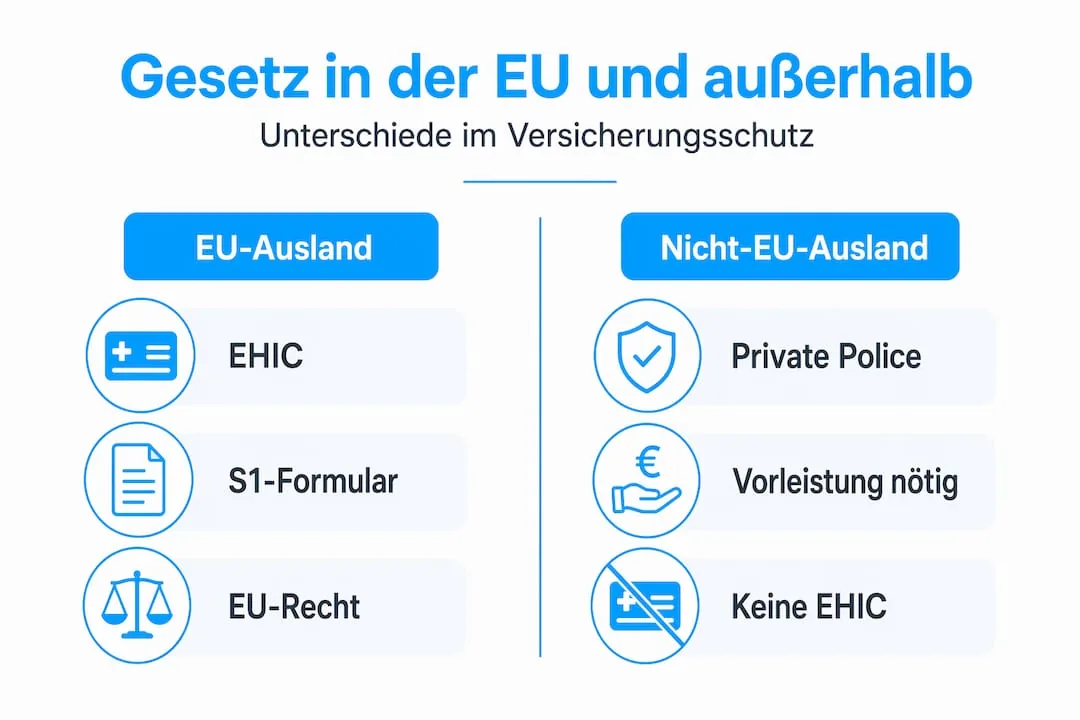
Comparison: EU countries vs. non-EU countries
| Aspect | EU countries | Non-EU countries |
|---|---|---|
| Legal basis | EU coordination rules, EHIC, S1 | Country-specific, agreement if any |
| Doctor visit | Public doctors with card | Often pay upfront, then claim reimbursement |
| Repatriation | Not included — supplement needed | Strongly recommended via private cover |
| Private supplement | Recommended | Practically essential |
| Forms | EHIC, S1 | Auslandskrankenschein, or none if no agreement |
Find the right international health insurance
You now know which document you need and where your statutory cover stops. The quickest way to find the right private supplement is a direct comparison. Free, no obligation, and you can see at a glance what each tariff actually covers abroad.
PKV-Vergleich wird geladen...
Common mistakes when applying
Applying too late
Both the EHIC and the S1 form take time to process. Plan ahead — well before your move.
Mixing up short stays and permanent relocation
The EHIC does not apply once you change your permanent residence. In that case, the S1 form is what you need.
Seeing a private doctor without supplementary cover
Private doctors are not reimbursed by the statutory fund.
No repatriation cover
A medical repatriation to Germany can run to very high costs.
Losing original invoices
Without original receipts, claiming reimbursement later becomes difficult or impossible.
Not checking benefit differences
Something covered in Germany can be excluded abroad. Always verify.
Documentation, reimbursement and lasting cover
Application filed, card in hand. Now comes the part most people forget to plan for: keeping your coverage in order while you are actually abroad.
Filing reimbursement claims correctly
- Keep every invoice: every consultation, prescription and hospital bill in the original.
- Submit original receipts: EU cross-border reimbursements require detailed receipts — the European Consumer Centre (EVZ) explains the process.
- File the reimbursement request: with the foreign or the German statutory insurer.
- Watch the deadlines: usually 3 to 12 months after treatment.
- Get written confirmation: always ask the insurer to acknowledge receipt in writing.
Pro tip: Keep a digital folder with all key documents as PDFs: insurance card, S1 form, passport, residence permit and your insurer's contact details.
If your current cover shows gaps — repatriation, dental, free choice of doctor — topping up makes sense. Use a health insurance comparison to find suitable tariffs quickly.
Editorial recommendation from meinetarife24
The biggest problem is rarely the insurance itself — it is the planning. People who only call their statutory insurer a few weeks before moving feel rushed. The S1 form arrives late, registration with the foreign body drags on, and a coverage gap opens up.
Start the conversation with your insurer around 3 months before departure. That call often surfaces questions you had not thought of: do I actually need an S1, or does the EHIC cover my situation? What happens to my insurance if I work abroad? Are children moving with me covered? The DVKA, the Federal Ministry of Health (“Versicherungsschutz im Ausland”) and the EU portal “Your Europe” are reliable sources for the answers.
Supplementary private cover gets dismissed as a luxury too often. In countries with long public waiting times it is simply a practical way to see a specialist without months of delay. Work through it in three steps: lock down the statutory baseline (EHIC or S1), identify the gaps (repatriation, private clinic, dental), then add the right supplement.
Compare insurance options now
Use the insurance comparison on meinetarife24.de to find suitable tariffs for international health, liability and other policies quickly. Free, GDPR-compliant and available in German, English and Turkish.