Insurance Premium in Germany: What You Actually Pay For
If you live in Germany, you pay insurance premiums. But how are they calculated? What can you do when they go up? This guide breaks it all down in plain English.

Table of Contents
Key German Terms You Need to Know
Versicherungspraemie
Insurance premium
Beitrag
Contribution (public insurance)
Selbstbeteiligung
Deductible / excess
Risikozuschlag
Risk surcharge
Schadenfreiheitsklasse
No-claims bonus class
Nettopraemie
Net premium (risk only)
Bruttopraemie
Gross premium (total cost)
Versicherungsvertrag
Insurance contract
Key Findings at a Glance
| Point | Details |
|---|---|
| Praemie vs. Beitrag | Praemie is used for private insurance; Beitrag for statutory (public) insurance. Both mean the amount you pay. |
| Three Components | Every premium consists of a net risk premium, administrative costs, and a safety/profit margin. |
| Risk Assessment | Insurers use actuarial data (age, health, claims history, location) to calculate your individual risk. |
| Legal Protection | Paragraph 41 VVG gives you the right to transparency about risk surcharges and premium calculations. |
| Savings Potential | Comparing insurers can save hundreds of euros per year, even for the exact same coverage. |

How Are Insurance Premiums Calculated in Germany?
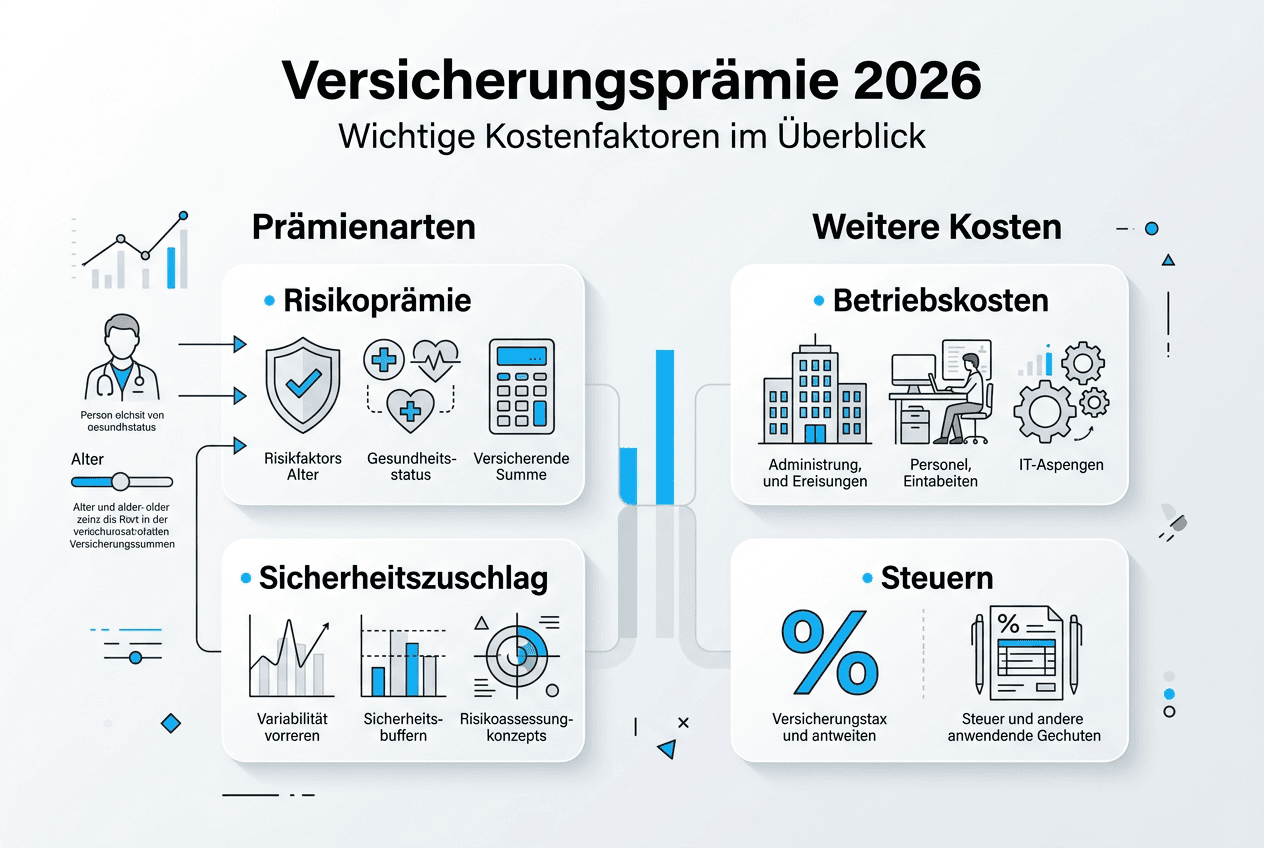
Behind every premium is a careful calculation by actuaries (Versicherungsmathematiker). These specialists use statistical data to predict how likely it is that you will file a claim and how much that claim will cost. Here is a simplified breakdown of what makes up your premium:
| Component | What It Covers | Share |
|---|---|---|
| Net Risk Premium | Covers the statistical cost of expected claims | 60-70% |
| Administrative Costs | Staff, offices, IT systems, claims processing | 15-20% |
| Agent Commission | Compensation for insurance brokers or agents | 5-10% |
| Safety Margin | Buffer for unexpectedly high claims years | 3-5% |
| Profit Margin | The insurer's business profit | 2-5% |
Factors That Influence Your Individual Premium
Two people with the same insurance policy can pay very different amounts. Insurers adjust your premium based on your personal risk profile. Here are the most common factors:
Older policyholders and those with pre-existing conditions generally pay higher premiums, especially in private health and life insurance.
In car insurance, your Schadenfreiheitsklasse (no-claims class) is crucial. Each claim-free year lowers your premium; each claim raises it.
Where you live matters. Areas with higher theft or accident rates have higher premiums. This is captured in the Regionalklasse (regional class).
Higher coverage means higher premiums. Choosing a higher deductible (Selbstbeteiligung) reduces your premium because you take on more risk yourself.
Some insurers offer discounts for public servants (Beamte) or certain professions considered lower risk.
Paying annually is cheaper than monthly. Insurers typically add a 5-10% surcharge for monthly or quarterly payments.
Pro Tip
For a detailed look at how premium calculation works in the insurance industry, the Versicherungsmagazin Lexikon offers an in-depth explanation (in German). If you are curious about the math behind it, it is worth a read.
Risk Surcharges and Your Legal Rights
Sometimes your premium includes an extra charge called a Risikozuschlag (risk surcharge). This happens when the insurer considers you a higher-than-average risk. Common reasons include pre-existing health conditions, a high-risk profession, or a poor claims history.
What Does German Law Say?
The German Insurance Contract Act (Paragraph 41 VVG) establishes important rules about premium adjustments. In plain English, here is what it means for you:
Your Rights Under German Insurance Law
- Transparency: Insurers must clearly state any risk surcharges and explain why they apply to you.
- Proportionality: Surcharges must be proportionate to the actual increased risk — they cannot be arbitrary.
- Right to Cancel: If your premium is increased, you typically have a special cancellation right (Sonderkuendigungsrecht) within one month.
- No Discrimination: Nationality alone cannot be a reason for higher premiums under German anti-discrimination law (AGG).
Watch Out for Hidden Premium Increases
Some insurers raise premiums not by changing the amount directly, but by reclassifying risk categories or adjusting coverage terms. Always read your renewal letter (Beitragsanpassung) carefully. If anything changes, you may have the right to cancel and switch to a better offer.
If you believe a surcharge is unfair, you can file a complaint with the insurance ombudsman (Versicherungsombudsmann). This is a free service in Germany that mediates between customers and insurers. You can also seek advice from a consumer protection center (Verbraucherzentrale).
Paying Too Much? Compare Your Insurance Now
Use our free comparison tool and find out in minutes if you can get the same coverage for less. Independent, transparent, and GDPR-compliant.
Special Tips for Expats and Newcomers
Navigating the German insurance system can feel overwhelming when you are new to the country. Here are some specific things to keep in mind:
Transfer Your Claims History
For car insurance, some German insurers accept your no-claims history from your home country. Bring a letter from your previous insurer confirming your claim-free years. This can save you from starting at the expensive SF0 class.
Understand Mandatory vs. Optional Insurance
In Germany, health insurance and car liability insurance are mandatory. Household contents insurance (Hausratversicherung) and personal liability insurance (Haftpflichtversicherung) are technically optional but strongly recommended. Visit our insurance topics page for a full overview.
Use English-Friendly Comparison Tools
Most German insurance comparison websites are in German only. At meinetarife24.de, we provide multilingual guides and comparison tools to help you find the right coverage without a language barrier.
Do Not Over-Insure or Under-Insure
Germans tend to be heavily insured, but that does not mean you need every policy. Focus on the essentials first (health, liability, car if applicable), then add coverage as your situation requires. Our expat insurance guide can help you prioritize.
“The biggest mistake expats make is keeping the first insurance they signed up for without ever comparing alternatives. Even one comparison per year can save you hundreds of euros.”
Frequently Asked Questions
Find the Right Insurance at the Right Price
Do not overpay for insurance in Germany. Compare offers from multiple providers in minutes and find the coverage that fits your needs and your budget.
Compare Insurance Now