Guide · Housing & Energy · 2026
Save on utility costs in Germany 2026: check and cut your bills
Here is how to lower your utility costs (German: Nebenkosten) in Germany: read your annual statement properly, use the legal deadlines, and keep money each year that would otherwise go to your landlord or energy supplier by using less heating, hot water and electricity.
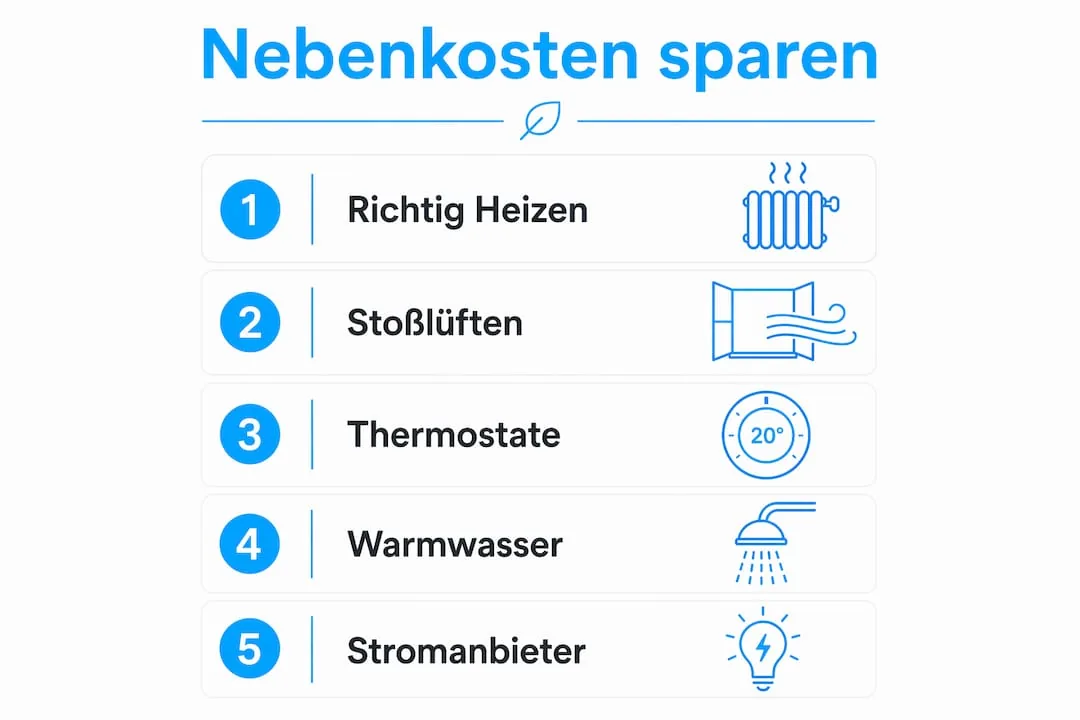
The key points at a glance
The biggest source of savings in your utility costs is the annual statement itself: if it reaches you later than twelve months after the end of the accounting period, your landlord usually can no longer demand a back-payment (German: Nachzahlung) under § 556 Abs. 3 BGB. On the consumption side, heating, hot water and electricity bring the most, and an annual tariff comparison for electricity and gas lowers your running costs on top. Heating and hot water make up roughly half of your utility costs, so this is where every measure pays off the most.
meinetarife24 Editorial Team
Our editorial team writes the content and updates it regularly.
Utility costs are the running operating costs of your flat that come on top of the base rent (German: Kaltmiete): heating, hot water, water, waste, the caretaker, property tax and more. In an average household these easily add up to a few thousand euros a year, which is why Germans often call them the "second rent". The good news: you can claw some of it back without giving up any comfort. There are two levers: your rights as a tenant (a properly checked statement) and your consumption (heating, hot water, electricity). We will work through both, one after the other.
Kaltmiete, Warmmiete, Nebenkosten: a quick explainer
If you are new to Germany, these terms often cause confusion. Here are the most important ones in plain language:
- Base rent (Kaltmiete): the pure rent for the flat, without any utility costs.
- Utility costs (Nebenkosten, also Betriebskosten): all the running costs around the flat, such as heating, water and waste. You pay them monthly as an advance payment (Vorauszahlung).
- Warm rent (Warmmiete): base rent plus the utility advance payment. This is the amount that actually leaves your account.
- Back-payment or credit (Nachzahlung oder Guthaben): once a year your landlord settles up. If you paid too little in advance, you owe a back-payment. If you paid too much, you get money back.
This yearly statement is exactly where most tenants leave money on the table, because they never check it. So let us start there.
Checking your annual statement: the most important source of savings
Your utility statement (Nebenkostenabrechnung) must reach you no later than twelve months after the end of the accounting period. This deadline is set out in § 556 Abs. 3 BGB. If the statement arrives too late, your landlord normally can no longer demand a back-payment. The one exception: when the delay is not the landlord’s fault, for example because consumption data from a supplier is still missing. A credit, however, the landlord must still pay out to you.
Once you receive the statement, you have twelve months of your own to raise objections. Use that time and go through the statement item by item. Many statements contain mistakes, from wrong allocation keys to costs that are not allowed to be passed on to tenants at all. The Verbraucherzentrale (consumer advice centre) offers a paid check for this, and many tenants’ associations check the statement free of charge for members.
These costs your landlord may not pass on
Which cost types may be passed on to you at all is governed by the Operating Costs Ordinance (§ 1 BetrKV). Among the items that are not apportionable are:
- Administrative costs such as property management, bookkeeping and account management.
- Maintenance and repairs, which the landlord bears alone.
- Vacancy costs for flats in the building that are not rented out.
- Insurance unrelated to the property, for example the landlord’s legal-protection insurance.
Pro tip: Note down the date the statement arrives and keep the envelope or the email. That way, if there is ever a dispute, you can prove whether the twelve-month deadline was met.
Are your utility costs around average?
To judge whether your statement is realistic, it helps to look at the average. The Betriebskostenspiegel published by the German Tenants’ Association (Deutscher Mieterbund) shows what households pay on average per square metre.
| Figure | Guideline value |
|---|---|
| Total operating costs (average) | around 2.67 euros per m² and month |
| Example: 70 m² flat | about 2,240 euros per year |
| Largest share | heating and hot water, roughly half |
Guideline values per the Betriebskostenspiegel of the Deutscher Mieterbund. Your actual costs depend on the building, the region and your consumption. If your statement is well above these figures, a close check is worth it.
Heating: the largest item in your utility costs
Together, heating and hot water make up roughly half of your utility costs, in many households between 40 and 60 percent. Starting here gives you the biggest lever for the least effort.
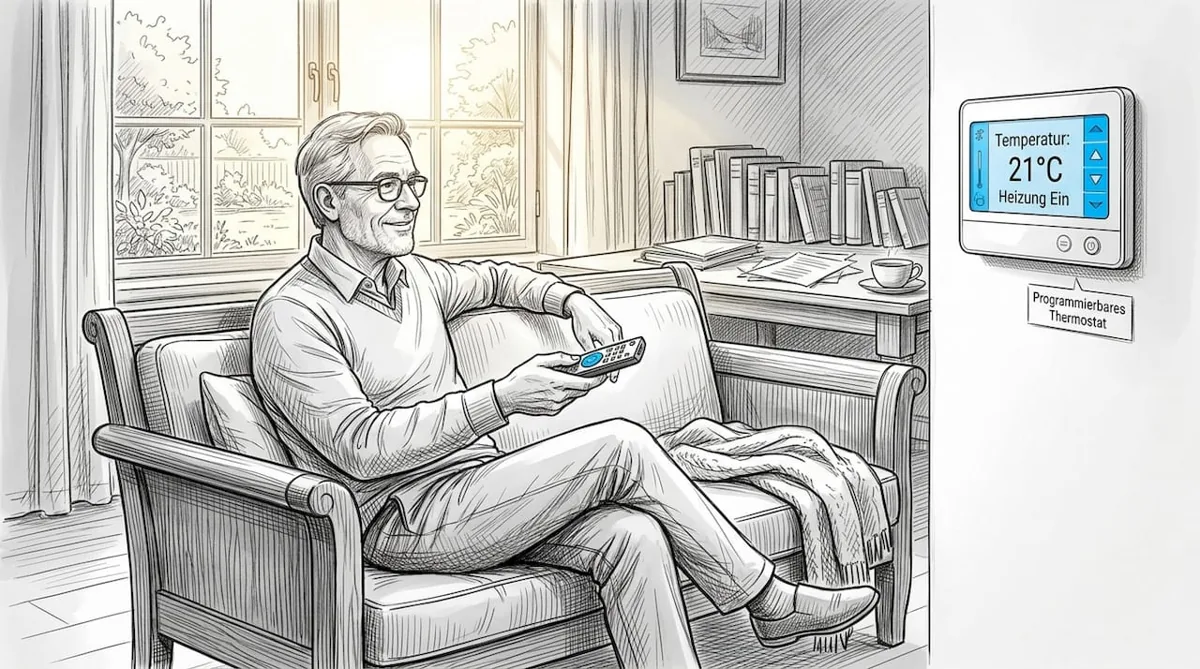
The simplest step costs nothing: turn the room temperature down a little. Each degree less saves roughly 6 percent of heating energy. From 22 down to 20 degrees, that is already around 12 percent. Bedrooms often only need 16 to 18 degrees, living rooms 20 to 21 degrees. For airing out, the rule is: open the windows fully three to four times a day for about ten minutes rather than leaving them permanently on the tilt. That way the air is exchanged without letting the walls and furniture cool down.
Thermostats and bleeding the radiators
Programmable thermostats adjust the temperature automatically by time of day and cost between 30 and 80 euros per radiator, depending on the model. Once per heating season you should also bleed the radiators: trapped air slows down the heat, and a quick bleed brings it back. Draughty windows and doors can be sealed with weatherstripping tape for a few euros.
Pro tip: Do not switch the heating off completely when you travel. A frost-protection setting of 12 to 14 degrees prevents damage and is cheaper than reheating a flat that has cooled down completely.
Reducing hot water
After heating, hot water is the second-largest item. A shower uses about half as much water as a full bath. If you switch from a daily bath to a short shower, you can noticeably cut your hot water use, and that feeds straight into your statement, because hot water is usually billed by consumption.
- Water-saving shower head: lowers the flow from 12 to 15 down to 6 to 8 litres per minute and costs 15 to 60 euros.
- Turn off the water while soaping up to save several litres per shower.
- Dishwasher instead of washing up by hand: modern machines only need 6 to 9 litres per cycle.
- Run the washing machine fully loaded, since half-full loads use almost as much.
Pro tip: Do not set the hot water temperature below 60 degrees. Below that, legionella can multiply in the pipe system. The health risk outweighs the small saving.
Cutting electricity and switching provider
A two-person household uses around 2,500 to 3,000 kilowatt-hours a year. Standby devices draw about 10 percent of that electricity, often 50 to 80 euros a year for kit that only appears to be off. Switchable power strips disconnect them completely from the mains.
- Cut standby: switch off the TV, router and console with a switchable power strip.
- LED instead of the old bulb: up to 80 percent less electricity for lighting.
- Wash at 30 or 40 degrees, which is enough for normal laundry.
- Mind the energy label: when buying new, choose appliances in the best classes.
- Compare your tariff and switch if there is a cheaper offer.
Switching your electricity provider is free and possible without any interruption to supply, according to the Bundesnetzagentur (Federal Network Agency). The new provider takes care of cancelling with the old supplier, and if anything goes wrong, the default basic supply (Grundversorgung) automatically kicks in. There is no real gap in supply in Germany.
Compare electricity tariffs directly
The quickest way to see your saving potential is to enter your postcode and your annual consumption. The calculator then shows which tariffs are cheaper than your current contract. The data comes directly from CHECK24, and you make the choice yourself.
Advertising disclosure (Werbehinweis): The tariff calculator is provided by our partner CHECK24. If you sign a contract through it, we earn a commission at no extra cost to you, and this does not affect the results shown.
Data Source & Transparency
The tariff data on this page is provided by CHECK24 and Tarifcheck. We do not alter prices, rankings, or how results are displayed.
Our role:
We provide editorial explanations and decision-making guidance. The actual tariff calculation and mediation is done by our partners.
What we do not cover:
Not all providers in the market are included in this comparison. Regional providers or specialized tariffs may be missing.
CO2 costs split between tenant and landlord
Since 1 January 2023, the CO2 costs for fossil heating are no longer carried by the tenant alone. The Carbon Dioxide Cost Allocation Act (CO2KostAufG) splits them on a sliding scale: the more poorly a building is insulated, the higher the landlord’s share. For the most poorly insulated buildings (from 52 kg CO2 per square metre and year), the landlord bears 95 percent and the tenant only 5 percent. If the split in your statement is wrong, you are allowed to reduce the amount.
Compare your electricity and gas tariff regularly
Electricity and gas prices change several times a year. If you never check your tariff, you often pay more than you need to. Three figures matter in the comparison:
- Base price (Grundpreis): the fixed monthly fee, usually 5 to 15 euros.
- Unit price (Arbeitspreis): the price per kilowatt-hour, the biggest factor when consumption is high.
- Term and notice period: watch out for automatic renewal.
The Verbraucherzentrale recommends comparing at least once a year, ideally about three months before the contract ends. You can find the gas comparison and the electricity comparison free of charge at any time on meinetarife24.de. According to the Verbraucherzentrale, switching away from the default basic supply can save several hundred euros a year, depending on your usage.
Key takeaways
- Check the statement first: If the utility statement arrives later than twelve months, the back-payment claim usually lapses (§ 556 Abs. 3 BGB).
- Know the non-apportionable costs: Administration, maintenance and vacancy may not be passed on to you by the landlord.
- Heating is the biggest lever: Heating and hot water make up roughly half of your utility costs. Each degree less saves about 6 percent.
- Cut standby and electricity: Switchable power strips and LED lighting noticeably reduce your electricity use.
- Compare tariffs every year: Switching electricity or gas is free and can save several hundred euros depending on your usage.
Compare tariffs and cut your utility costs for good
meinetarife24 compares electricity and gas tariffs from numerous providers in Germany and shows you in a few minutes how much a switch is worth. Everything is available in German, English and Turkish, which is handy when you are new to Germany. Switching is free and without obligation.
Frequently asked questions
How do I check my utility statement?
Match each item against your rental contract and check that only apportionable costs are included. Pay attention to the allocation key and your advance payments. When in doubt, a tenants’ association or the Verbraucherzentrale can help. You have twelve months after receiving the statement to raise objections.
What happens if the utility statement arrives too late?
If the statement arrives later than twelve months after the accounting period, your landlord usually can no longer demand a back-payment under § 556 Abs. 3 BGB. The only exception applies when the delay is not the landlord’s fault. A credit, however, the landlord must still pay out to you.
Which costs may the landlord not pass on?
Administrative costs, maintenance and repairs, and vacancy costs are not apportionable under § 1 of the Operating Costs Ordinance (BetrKV). Only the cost types defined there may appear in the statement.
How high are utility costs on average?
According to the Betriebskostenspiegel of the Deutscher Mieterbund, operating costs average around 2.67 euros per square metre and month. For a 70 m² flat that is about 2,240 euros a year. Heating and hot water make up roughly half of that.
How does the CO2 cost-sharing model work?
Since 1 January 2023, CO2 costs are split on a sliding scale between tenant and landlord. The poorer the building’s energy efficiency, the higher the landlord’s share, up to 95 percent for the most poorly insulated buildings.
Is it worth switching electricity or gas provider?
Switching is free and possible without any interruption to supply. According to the Verbraucherzentrale, switching away from the default basic supply can save several hundred euros a year, depending on your usage. It is best to compare once a year.
Sources & methodology
We verified every legal statement in this guide against the original sources. The most important ones:
- § 556 BGB – agreements on operating costs (billing deadline)
- § 1 BetrKV – apportionable and non-apportionable costs
- CO2KostAufG – allocation of CO2 costs
- Deutscher Mieterbund – Betriebskostenspiegel
- Verbraucherzentrale – switching electricity and gas provider
- Bundesnetzagentur – changing supplier