
Many people in Germany believe that statutory health insurance guarantees stable premiums. This assumption is misleading. Actual costs fluctuate significantly through individual additional contributions from each health fund, while private health insurance sees average premium adjustments of 13% in 2026. This article clarifies the differences between GKV and PKV, explains premium developments and political reforms, and shows you how to find optimal coverage at minimized costs through targeted comparison.
Key Findings at a Glance
| Topic | Details |
|---|---|
| Statutory Health Insurance (GKV) | Contribution rates are income-dependent and supplemented by individual additional contributions from each health fund. |
| Private Health Insurance (PKV) | PKV sees average premium adjustments of 13% in 2026 with individual tariff options. |
| Political Reforms | Federal cabinet passes measures to stabilize GKV contributions until 2029 through cost limitations. |
| Digital Innovations | Health insurers use AI and digital platforms for improved service and efficient processes. |
| Comparison Platforms | Online platforms enable cost savings of up to 850 euros annually through targeted tariff comparisons. |
Basics of Health Insurance in Germany
The German health insurance system consists of two main pillars: statutory health insurance (GKV) and private health insurance (PKV). This structure ensures comprehensive healthcare for all residents.
GKV is based on the solidarity principle. Contribution rates are calculated based on income and supplemented by individual additional contributions. Family members without their own income are insured free of charge, which is particularly attractive for international professionals with families.
PKV works on different principles. Premiums are based on age, health status and chosen coverage scope at contract signing. It offers individually tailored tariffs with often more comprehensive benefits than GKV.
Employees with income below the compulsory insurance threshold must be insured in GKV
Self-employed, freelancers and high earners above the threshold can switch to PKV
Civil servants receive state aid and often choose PKV tariffs as supplement
International professionals need health insurance upon arrival in Germany
Both systems cover basic medical care but differ in additional services. GKV guarantees a defined benefits catalog, while PKV offers customized packages. For individuals and expats, a thorough insurance comparison is essential to identify the right system.
Contribution Rates and Additional Premiums in GKV and PKV 2026
Health insurance financing in Germany shows significant changes in 2026. The contribution assessment ceiling is 69,750 euros annually, which corresponds to 5,812.50 euros monthly. Income beyond this amount remains contribution-free.
The average GKV contribution in 2026, including the individual additional contribution, is approximately 17.5% of assessable income. This percentage is shared between employer and employee, with the additional contribution shared by both sides.
| Category | GKV 2026 | PKV 2026 |
|---|---|---|
| Contribution Ceiling | 69,750 EUR annually | Not applicable |
| Average Contribution | ~17.5% of income | Individual by age/risk |
| Additional Contribution | 2.9% average | Included in total premium |
| Premium Adjustment | Moderately stabilized | Average 13% |
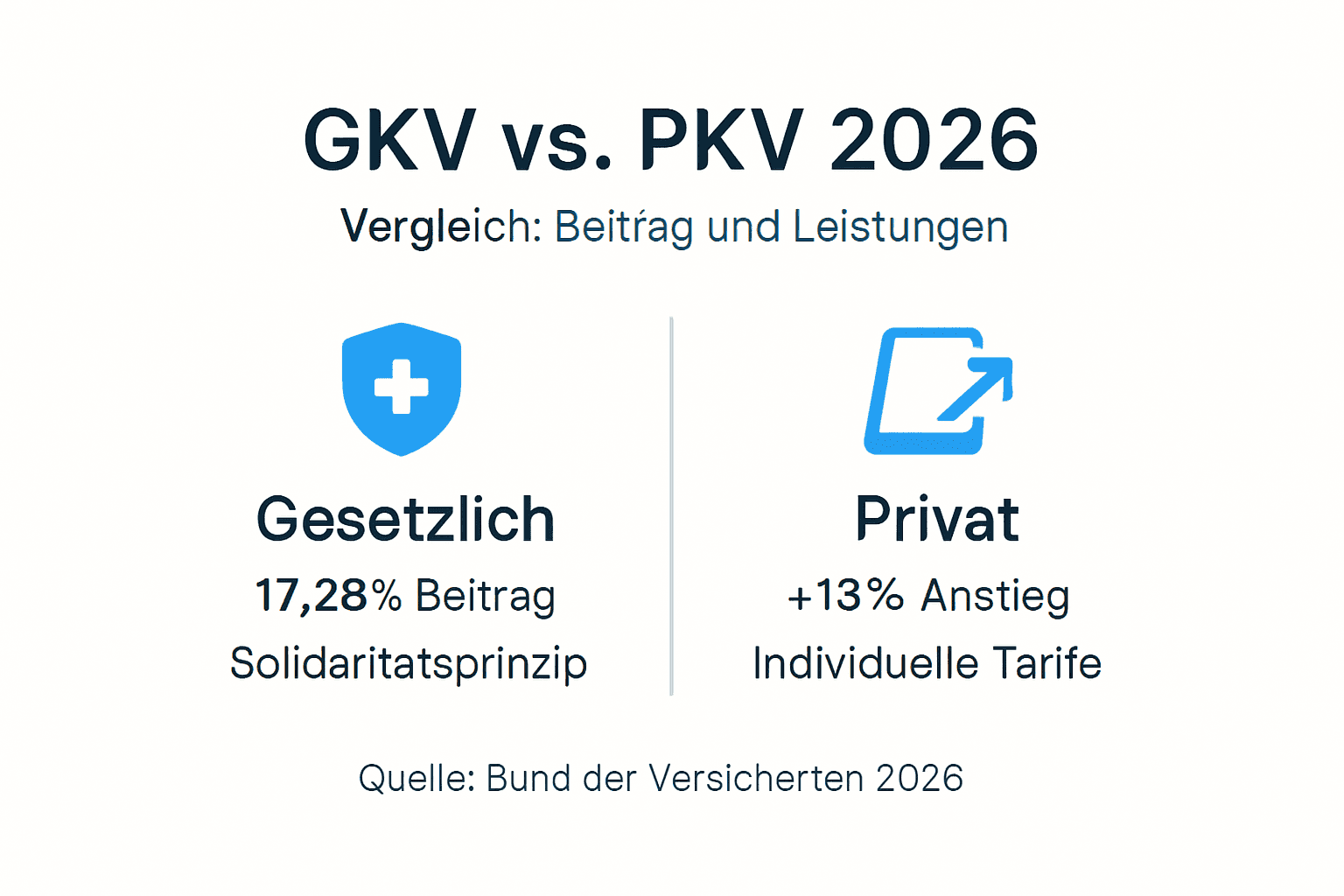
Private health insurance adjusts premiums by an average of 13% in 2026. This increase results from higher healthcare costs, rising physician fees and increasing treatment costs. PKV policyholders feel this development directly in their monthly premiums.
The mini-job threshold rises to 603 euros monthly
Compulsory insurance threshold (JAEG) is 77,400 euros annually in 2026
Long-term care insurance contributions remain linked to health insurance
Additional contributions vary significantly between health funds
Pro Tip
Check your GKV's individual additional contributions annually. Differences of up to 1.5 percentage points between health funds mean savings of up to 750 euros per year on a 50,000 euro income. Use online comparison platforms for quick overviews and switch at year-end if needed.
Political Reforms and Financing Strategies 2026
The German government responds in 2026 with concrete measures to growing cost pressure in the healthcare system. The federal cabinet has passed measures to stabilize additional contributions in statutory health insurance and reduce existing deficits.
Limiting hospital fee increases for cost control
Capping administrative costs at health funds to maximum 5% of total spending
Reducing the innovation fund by 150 million euros to cover financing gaps
Increasing efficiency in pharmaceutical supply through price negotiations
These interventions target premium development directly. Additional contributions should be stabilized until 2029, despite rising treatment costs and demographic challenges. The Federal Ministry of Health expects a structural deficit of several billion euros, which these measures should gradually reduce.
For international professionals, this political stabilization strategy means more predictable costs. The reform measures create a more reliable framework for your financial planning in Germany.
Differences, Advantages and Challenges of GKV and PKV
The choice between statutory and private health insurance depends on individual factors. Both systems are subject to cost increases, with PKV often showing stronger premium adjustments.

| Criterion | GKV | PKV |
|---|---|---|
| Premium Calculation | Income-dependent up to ceiling | Age, health, coverage scope |
| Family Insurance | Free for dependents | Each person pays own premium |
| Coverage Scope | Legally defined catalog | Individually selectable and expandable |
| Specialist Wait Times | Sometimes longer | Often priority appointments |
| Premium Development | Stable with additional contributions | 2026 average +13% |
| Health Examination | None required | Comprehensive before contract |
| Switching Options | Annually with higher additional contribution | Difficult after entry |
GKV scores with predictability. Your contribution rises proportionally with income but stays constant once the contribution ceiling is reached. Families benefit enormously from free co-insurance, which is particularly attractive for international professionals with partners and children.
Free choice of doctors and hospitals nationwide
Chief physician treatment and private room in hospital
Alternative healing methods and extended dental treatments
Shorter waiting times through priority appointment scheduling
Pro Tip
Young, healthy high earners often pay less in PKV than in GKV. However, PKV premiums rise significantly with age, while GKV contributions remain income-dependent. Calculate long-term and consider ageing reserves (Altersrueckstellungen).
For international professionals, there are special considerations. Private tariffs for expats often offer multilingual service and international coverage. Some employers subsidize PKV contributions for foreign employees. Check full health insurance comparison options thoroughly before deciding.
Innovation and Digitalization in Health Insurance
The health insurance industry is undergoing a digital transformation. Digitalization enables process optimization and better customer access through modern technologies and automated systems.
Artificial intelligence is revolutionizing claims management. Algorithms check invoices automatically, detect discrepancies and speed up reimbursements. As a policyholder, you benefit from shorter processing times and less bureaucratic effort.
Online applications without paperwork in just minutes
Mobile apps for invoice submission by photo
Video consultations with doctors for quick initial advice
Digital health records with complete treatment history
Chatbots for 24/7 customer service for standard questions
Pro Tip
Choose insurers with mature digital platforms. Self-service portals with document upload, contract overview and direct communication save you time. Look for providers with digital focus that process your requests within hours instead of days.
The digital evolution creates new business models. Insurtech startups offer flexible micro-insurance and usage-based tariffs. Established insurers cooperate with technology companies to remain competitive and develop innovative solutions.
Common Misconceptions and Clarifications
Many policyholders have misconceptions about health insurance in Germany. These misunderstandings often lead to suboptimal decisions and unnecessarily high costs.
Misconception 1: GKV contributions are uniform and stable nationwide
While the general contribution rate is uniform, individual additional contributions vary significantly. Differences of 0.9% to over 3.5% between health funds are common, which for middle incomes means several hundred euros annually.
Misconception 2: Private health insurance is always more expensive than GKV
This is not universally true. Young, healthy people with high income often pay significantly less in PKV than the maximum GKV contribution. It becomes problematic with age, when PKV premiums rise while GKV contributions for retirees are often lower.
Misconception 3: PKV tariffs cannot be compared
Tariffs can actually be systematically evaluated based on benefit catalogs, deductibles and premiums. Online platforms make this comparison transparent and accessible.
International professionals have access to both systems if they meet the requirements
Switching from PKV back to GKV is practically impossible after age 55
Additional contributions can change annually, policyholders should compare regularly
Practical Guide to Tariff Selection and Cost Savings
Finding the right health insurance requires a systematic approach. Online comparison platforms enable savings of up to 850 euros annually on health insurance tariffs through transparent comparison.
Record your personal profile with age, health status, income and family situation
Check your current premium level and compare with alternatives in your category
Compare coverage scope systematically using standardized criteria such as dental, eyewear and hospital extras
Evaluate tariff options considering deductibles, premium refunds and coverage exclusions
Calculate realistic cost savings over multiple years, not just the current premium difference
Pro Tip
Update your tariff comparison annually before year-end. The notice period for GKV switching is two months to month-end. When premiums increase, you have a special cancellation right. Set an annual reminder to check switching options.
Find Optimal Health Insurance with meinetarife24.de
Through systematic comparison of private health insurance, you can realize savings of up to 850 euros per year. Multilingual support in German, English and Turkish.
Frequently Asked Questions
Recommended Reading
PKV Comparison 2026 | Compare Private Health Insurance
Find the optimal PKV tariff for your needs
PKV for Civil Servants 2026 | Aid-Compliant Tariffs
Special aid-compliant tariffs for civil servants
Full Health Insurance Comparison 2026 | PKV Tariffs
Comprehensive comparison of full health insurance plans
PKV for Students 2026 | Affordable Tariffs
Special PKV tariffs for students in Germany