
A lot of people assume statutory health insurance means stable costs, while private insurance is just expensive. Neither is quite right. In GKV, the part that fluctuates most is the individual additional contribution (Zusatzbeitrag) set by each fund. And in PKV, premiums are not all moving the same way in 2026 — according to the PKV-Verband, somewhere between half and two-thirds of contracts are affected. This guide explains what is actually changing, what rights you have when your premium goes up, and how to make the GKV-versus-PKV decision as a newcomer.
Do All PKV Premiums Really Rise 13% in 2026?
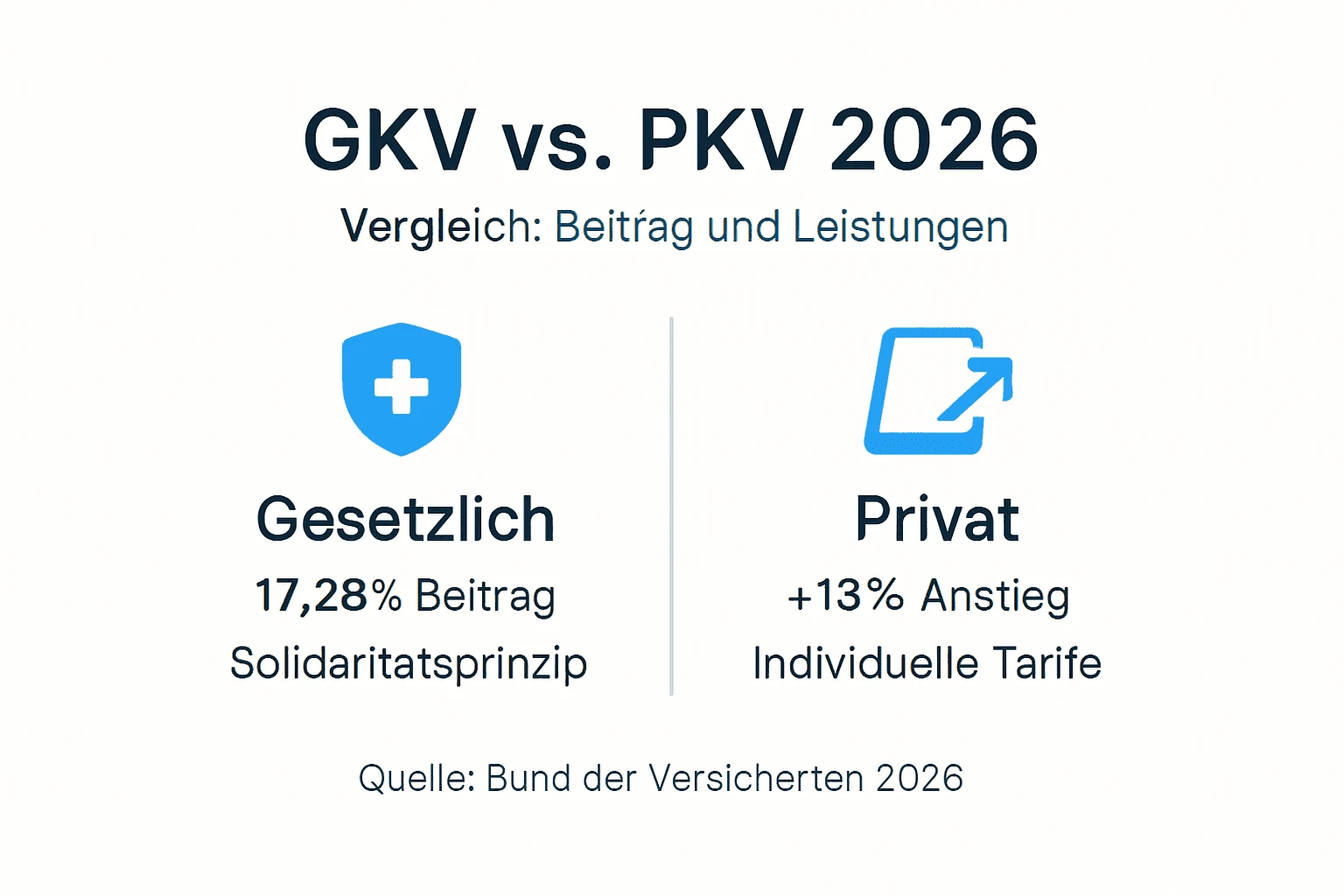
No. The 13% figure you often see is an average, and it only applies to the policyholders whose premiums are being adjusted at all. The PKV-Verband puts that group at around 60% of privately insured people. The other roughly 40% see no change this year. How much your own premium moves, or whether it moves at all, depends on your specific tariff and insurer — that information is in the letter your insurer sends you.
The underlying drivers are higher treatment costs, rising physician fees, and more expensive medicines. Over the long run, PKV and GKV have actually tracked each other fairly closely: according to the research institute of the PKV-Verband, premiums in both systems grew at roughly similar annual rates between 2006 and 2026.
| Category | GKV 2026 | PKV 2026 |
|---|---|---|
| Contribution Ceiling | EUR 69,750/year (EUR 5,812.50/month) | Not applicable |
| Average Contribution | ~17.5% of income (14.6% + 2.9%) | Individual — age, health, coverage |
| Additional Contribution 2026 | Avg. 2.9% (varies by fund) | Included in total premium |
| Premium Adjustment 2026 | Moderately increased | For ~60%, avg. ~13% (PKV-Verband) |
What Changes in 2026 at a Glance
| Topic | Details |
|---|---|
| Who is affected? | According to the PKV-Verband, around 60% of privately insured people receive an adjustment in 2026, averaging about 13%. The other roughly 40% see no change. |
| GKV additional contribution 2026 | The average Zusatzbeitrag rises to 2.9% (from 2.5%). The general rate stays at 14.6%. |
| Your special cancellation right | When premiums rise you can act: PKV § 205 VVG, GKV § 175 SGB V, or switch tariffs under § 204 VVG. |
| Reform through 2029 | The GKV-Beitragssatzstabilisierungsgesetz (Federal Cabinet, 29 April 2026) aims to stabilise contributions through 2029. |
| Key for newcomers | Insurance is mandatory from day one. The JAEG is EUR 77,400 in 2026. Returning from PKV to GKV after 55 is practically blocked. |
How Health Insurance Works in Germany
Germany has two parallel systems: statutory health insurance (gesetzliche Krankenversicherung, GKV) and private health insurance (private Krankenversicherung, PKV). GKV runs on the solidarity principle — your contribution is proportional to your income, and dependent family members are covered free of charge. That free family cover is a significant advantage for international professionals with a partner or children.
PKV works differently. Your premium is fixed at sign-up based on your age, health status, and the level of cover you choose. You can get broader benefits than GKV, but each family member pays their own premium.
Employees earning below the compulsory insurance threshold must be in GKV.
Self-employed people, freelancers, and high earners above the threshold can choose PKV.
Civil servants (Beamte) receive a state subsidy (Beihilfe) and typically top it up with a PKV tariff.
Newcomers need health insurance cover from the moment they arrive in Germany.
Both systems cover basic medical care. GKV provides a fixed statutory benefits catalog; PKV lets you tailor cover more individually. For expats and newcomers, a thorough insurance comparison is worth doing before you commit.
Contribution Rates and Additional Premiums in 2026
In GKV, the general contribution rate stays at 14.6% in 2026. On top of that comes the fund-specific additional contribution (Zusatzbeitrag), which averages 2.9% this year — up from 2.5% in 2025. Together that is roughly 17.5% of your assessable income, split between you and your employer. Contributions only apply up to the contribution ceiling (Beitragsbemessungsgrenze): EUR 69,750 per year, or EUR 5,812.50 per month.
The biggest practical difference is in the Zusatzbeitrag: funds differ by over 1.5 percentage points. On a EUR 50,000 annual salary, that gap works out to roughly several hundred euros a year. Switching funds is worth checking.
The compulsory insurance threshold (JAEG) is EUR 77,400 per year in 2026. Only employees above that can switch to PKV.
Zusatzbeiträge vary significantly between funds — an annual check is worthwhile.
Long-term care insurance (Pflegeversicherung) stays linked to health insurance: 3.6% in 2026, plus a 0.6% surcharge for those without children.
Tip
Check your fund's Zusatzbeitrag once a year. Moving to a fund with the same coverage but a lower additional contribution means more take-home pay. If your fund raises its rate, you have a special cancellation right and can act immediately.
For Newcomers and Expats: GKV or PKV?
If you're new to Germany, the percentage change in this year's premiums matters less than the foundational question: which system do you actually start in? That choice has long-term consequences you need to understand before signing anything.
JAEG entry threshold: As an employee, you can only switch to PKV once you earn above EUR 77,400 gross per year (2026). Below that, GKV is mandatory.
Employer subsidy: Under § 257 SGB V, your employer also contributes to PKV — up to half your premium, capped at the GKV maximum employer contribution.
Leaving Germany temporarily? An Anwartschaft (standby coverage) lets you pause your PKV contract and return later without a new health examination.
The return route is narrow: If your salary drops below the JAEG again, moving back to GKV as an employee is only possible under limited conditions. After age 55, § 6 SGB V makes it practically impossible.
This is why the first decision matters so much. Take time to compare in your own language and think about the long term, not just the initial premium.
Compare PKV Tariffs 2026
Want a first overview? The free comparison shows tariffs from multiple insurers side by side. No obligation — you decide if and when to get in touch.
PKV-Vergleich wird geladen...
Government Reforms 2026: What the Policy Actually Says
To counter rising costs in the health system, the Federal Cabinet (Bundeskabinett) adopted the GKV-Beitragssatzstabilisierungsgesetz on 29 April 2026. The aim is to stabilise additional contributions through 2029. This is a government draft — it is intended to stabilise costs, but it does not guarantee them.
Hospital fee increases are capped at the Grundlohnrate (basic wage index).
Administrative costs at health funds are permanently capped; spending on advertising is halved.
A one-percentage-point discount on fee increases is intended to apply in 2027, 2028, and 2029.
The Federal Ministry of Health (Bundesgesundheitsministerium) estimates the GKV funding gap for 2026 at around EUR 2 billion — addressed through the higher Zusatzbeitrag. The larger figures sometimes cited in the debate relate to projected shortfalls for 2027–2029, not 2026.
For international professionals this means somewhat more predictability, but no certainty. The government intends to dampen cost growth; the outcome remains to be seen.
GKV and PKV: Side-by-Side
Which system suits you depends on your income, family situation, age, and health. Both are getting more expensive; PKV tends to show sharper jumps in individual years.

| Criterion | GKV | PKV |
|---|---|---|
| Premium Calculation | Income-dependent up to ceiling | Age, health, coverage scope |
| Family Insurance | Free for dependents | Each person pays own premium |
| Coverage Scope | Legally defined catalog | Individually selectable and expandable |
| Premium in Retirement | Income-dependent, often manageable | Can rise significantly without reserves |
| Health Examination | None | Comprehensive before contract |
| Return to GKV | Standard for mandatory members | Practically blocked after 55 (§ 6 SGB V) |
Tip
Young, healthy high earners often start paying less in PKV than in GKV. Over time, PKV premiums tend to rise more steeply, while GKV contributions stay income-proportional. Calculate over a multi-decade horizon and look carefully at how the ageing reserves (Alterungsrückstellungen) work. For expats, many full health insurance plans offer multilingual service and international coverage.
Your Rights When Premiums Rise
A premium increase doesn't mean you simply have to accept it. Depending on your system, you have several options:
PKV, special cancellation (§ 205 VVG): After an increase you can cancel within two months of receiving the notice, effective from the date the increase takes effect. You need seamless replacement cover in place before your current policy ends.
PKV, tariff switch (§ 204 VVG): Often the better option. You switch to a cheaper tariff within the same insurer at comparable benefit levels, and take your ageing reserves with you.
GKV (§ 175 SGB V): When your fund raises its Zusatzbeitrag you can switch to another fund, even if your normal minimum membership period has not expired.
Important: In PKV, never cancel without seamless replacement cover lined up. Once you're out, getting back in at the same terms is much harder — especially with age or pre-existing conditions. The tariff switch under § 204 VVG is usually the safer lever.
Three Common Misconceptions
Misconception 1: GKV contributions are the same everywhere
The general rate is uniform, but the Zusatzbeitrag is not. Differences of over 1.5 percentage points between funds are common, which for a middle income means a few hundred euros a year.
Misconception 2: PKV is always more expensive than GKV
Not across the board. Young, healthy people on high incomes often pay less in PKV than the GKV maximum. The picture can reverse over time as PKV premiums rise with age.
Misconception 3: PKV tariffs cannot be compared
They can. Benefit catalog, deductible, and premium are all comparable. That is exactly what comparison portals are for.
Finding the Right Tariff in 5 Steps
A systematic approach works better than searching at random. Here is how to go about it:
Write down your profile: age, health history, income, and family situation.
Check your current contribution and compare it with alternatives in your category.
Compare benefits on consistent criteria: dental, eyewear, and hospital extras.
Factor in deductibles, premium refunds, and any coverage exclusions.
Calculate over several years, not just the current premium gap.
Tip
Set a calendar reminder before year-end. The standard GKV switching notice period is two months to month-end, but when a fund raises its Zusatzbeitrag you can act immediately. Staying alert means you stay flexible.
Compare Health Insurance with meinetarife24.de
Put PKV tariffs side by side, free and without commitment. Support in German, English, and Turkish.
Frequently Asked Questions
Related Comparisons
PKV Comparison 2026: Compare Private Health Insurance Tariffs
Find the right PKV tariff for your situation
PKV for Civil Servants 2026: Aid-Compliant Tariffs
Beihilfe-compliant tariffs for civil servants and trainees
Compare Statutory Health Funds: Zusatzbeitrag 2026
Compare GKV funds and their additional contribution rates
PKV for Students 2026
Tariffs for students and international students in Germany
Insurance Premium Explained: Definition and Costs 2026
What a premium is and which factors drive your costs