Disclosure: This article contains comparison and affiliate links. If you sign up through them we earn a commission at no extra cost to you. This does not influence our content. Prices and availability may change.
How to Switch Health Insurance in Germany 2026: Step-by-Step
You can switch your statutory health fund (Krankenkasse) once you have been a member for 12 months. After that, give two months' notice. If your fund raises the Zusatzbeitrag, you can switch straight away. Since 2021 the new fund handles the cancellation for you by law.
Last updated: June 2026 · meinetarife24 Editorial Team

Key Takeaways
- After 12 months of membership you can switch your statutory health fund, with two months' notice to the end of the month (§175 Abs. 4 SGB V).
- If your fund introduces or raises the Zusatzbeitrag, you have a Sonderkündigungsrecht, you can cancel until the end of the month the higher contribution is first charged. The 12-month binding does not apply.
- Since 2021 you no longer cancel the old fund yourself. Apply to the new fund and they report the switch, that report replaces your cancellation (§175 Abs. 4 S. 4 SGB V).
- The average Zusatzbeitrag in 2026 is 2.9% (BMG orientation value, +0.4 pp vs 2025). Each fund sets its own rate, comparing them is worth your time.
Table of Contents
Key Facts at a Glance
| Topic | Details |
|---|---|
| Minimum Membership | You must be insured with your current fund for at least 12 months before switching (§175 Abs. 4 SGB V). |
| Cancellation Period | After 12 months you can cancel to the end of the month after next, roughly two full months. |
| Special Cancellation Right | If your fund introduces or raises the Zusatzbeitrag, you can cancel immediately. The 12-month binding does not apply. |
| Who Files the Cancellation? | Since 2021 your NEW fund reports the switch and that report replaces your own cancellation (§175 Abs. 4 S. 4 SGB V). |
| Average Zusatzbeitrag 2026 | 2.9%, BMG orientation value, up 0.4 percentage points from 2025. Each fund sets its own rate. |
What You Need to Know Before Switching
Switching follows a clear set of rules. You are first bound to your statutory health fund for 12 months (§175 Abs. 4 S. 1 SGB V). After that, you can cancel to the end of the month after next, roughly two months. If you cancel in March, for example, you move to your new fund from June.
Whether switching makes sense depends on contribution rates and services. If you want to think through the decision first, our guide on when an insurance switch is worthwhile is a good starting point.
When the 12-Month Binding Does Not Apply
In certain situations you can switch earlier, without waiting out the first year:
Sonderkündigungsrecht (Special Cancellation Right)
The Sonderkündigungsrecht is your most powerful tool. If your fund introduces or raises the Zusatzbeitrag, you can cancel until the end of the month in which the higher contribution is first charged (§175 Abs. 4 SGB V). The 12-month binding plays no role in that case. When you start a new job, you also have a fresh right to choose any fund, your new employer simply needs to know which one you have chosen (§175 Abs. 2 SGB V).
Tip
Check your latest contribution notice. Many funds adjusted their Zusatzbeitrag at the turn of the year because the BMG orientation value for 2026 rose to 2.9%. If your fund raised its rate, you may have a Sonderkündigungsrecht right now, the 12-month binding no longer applies.
Step-by-Step: Switching Your Statutory Health Fund
The process is simpler than most people expect. Since 2021 almost everything runs through the new fund. These six steps take you through it:
- 1
Compare Zusatzbeitrag rates
Look at current rates across funds. The average in 2026 is 2.9% (BMG orientation value). Individual funds sit noticeably above or below that figure, so comparisons make a real difference.
- 2
Check extra benefits
Do not focus only on the contribution rate. Compare bonus programmes, preventive care, dental cleaning, osteopathy, and digital services too.
- 3
Choose your new fund
Pick the fund that fits both your budget and your healthcare needs. If English or Turkish support matters to you, ask the fund directly before signing up.
- 4
Apply for membership with the new fund
Submit a membership application. Since 2021 the new fund reports the switch to your old fund, and that report is your legal cancellation (§175 Abs. 4 S. 4 SGB V). You do not need to write a separate cancellation letter to the old fund.
- 5
Tell your employer
Inform your employer of your new fund so contributions are directed correctly. Simply pass on the name of the new fund; your employer handles the rest.
- 6
Receive your new health card
Your new fund will send you a membership confirmation and a new Gesundheitskarte (health card). Your coverage continues without any gap.
Tip
Register with the new fund before you stop thinking about the old one. Because the new fund handles the cancellation, there is no gap in coverage and no deadline you need to track yourself.

Common Mistakes When Switching Health Insurance
The switch is straightforward, but the same avoidable errors come up repeatedly. Here is what to watch out for:
More tips for saving when switching insurance are available in our dedicated guide.
Switching Health Insurance as an Expat or Newcomer
If you have recently moved to Germany, the same rules apply to you as to any other statutory-insured person. A few extra points are worth knowing:
- Anmeldung and social-security number first: You need a registered address (Anmeldung) and a Sozialversicherungsnummer before the switch can go through smoothly. Get these sorted before you apply to a new fund.
- English-speaking service: Several funds offer customer support in English and some in Turkish. Ask explicitly before signing up, it can make the paperwork far easier.
- GKV or PKV? If your gross income is above the Versicherungspflichtgrenze (€77,400/year in 2026), or you hold a Blue Card with a qualifying salary, or you are self-employed, private health insurance (PKV) may be available to you. Weigh this carefully: returning from PKV to GKV is generally not possible from age 55 (§6 Abs. 3a SGB V).
- Employer coordination: When you start a new job, you have a fresh right to choose any statutory fund (§175 Abs. 2 SGB V). Simply tell your employer which fund you have chosen; they coordinate the contribution payments.
For private health insurance options, relevant if you are above the income threshold or self-employed, use our comparison tool below.
Compare Private Health Insurance
Most people switching between statutory funds (GKV) do not need this widget. It is relevant if your gross income is above the Versicherungspflichtgrenze (€77,400/year in 2026), or you are self-employed, in which case private health insurance (PKV) may be an option worth exploring. For switching between statutory funds, use the statutory health fund comparison.
PKV-Vergleich wird geladen...
What Often Improves After Switching
Switching your health fund is not just about the contribution rate. Many switchers find their new fund offers noticeably better services and a more modern experience. Here is a quick health fund comparison to get you started.
| Before Switching | After Switching |
|---|---|
| Higher Zusatzbeitrag | Lower contribution rate |
| Few extra services | Bonus programmes and preventive care |
| Hard to reach by phone | App, online portal, faster processing |
| Rising costs without added value | Better value for money |
Pay particular attention to extras like professional dental cleaning, osteopathy, extended preventive care, or digital services. This is often where a genuinely good-fit fund stands apart from an average one.
How Much Can You Actually Save?
There is no single number, because your contribution depends on your income. You and your employer each pay half of the Zusatzbeitrag. What matters is the difference between your old and new fund's rate.
Worked Example
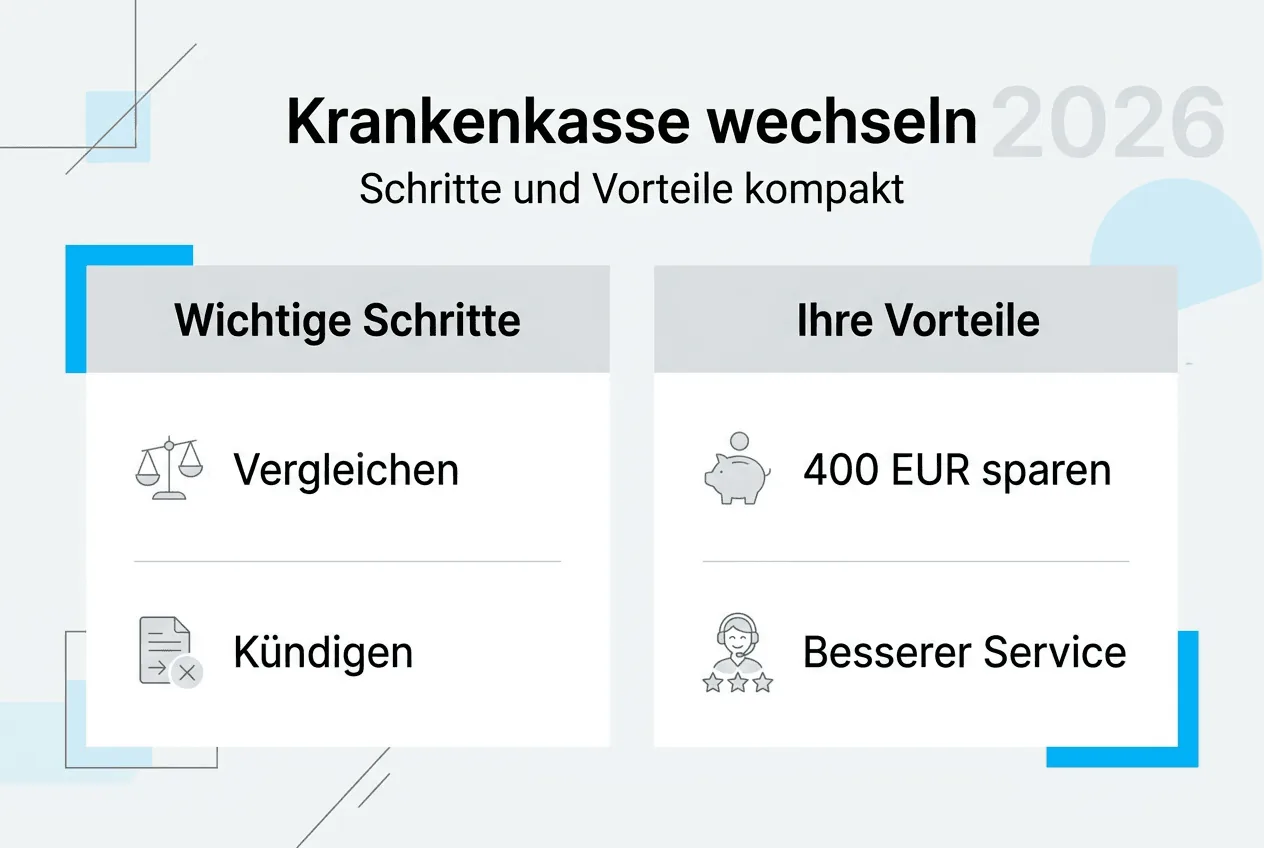
Say your new fund's Zusatzbeitrag is one percentage point lower than your current fund. With a gross salary of around €3,500/month, your share of the saving is roughly €17.50/month (half of 1% of €3,500), about €210 per year. At a higher income and a larger rate difference, the annual saving can reach around €400. The exact figure always depends on your specific income and the actual rate gap between the two funds.
One more thing: a fund that costs a few euros more but offers meaningful bonus programmes or better preventive care may deliver greater overall value than the cheapest option.
Compare Health Funds Now
Find out in minutes which fund matches your needs, contribution rate, services, and more. Free and no obligation.
Frequently Asked Questions
Ready to Switch?
With the average Zusatzbeitrag rising to 2.9% in 2026, comparing health funds is more worthwhile than ever. Find the option that suits you best.
Compare NowDisclosure: This article contains comparison and affiliate links. If you sign up through them we earn a commission at no extra cost to you. This does not influence our content. Prices and availability may change.