Choosing Health Insurance: The 2026 Guide
High contributions, confusing benefit catalogs, and uncertainty about switching. This guide clears up the most common misconceptions and shows what really matters in 2026: public vs private health insurance, selection criteria, and the simplified switching process.
Key Takeaways
Most employees in Germany are mandatorily covered by public health insurance (GKV). You can only move to private health insurance (PKV) once your gross annual income exceeds the 2026 income threshold (JAEG) of 77,400 euros, or if self-employment is your main occupation (self-employed artists and publicists are usually insured in the public system through the Künstlersozialkasse, KSK), or if you are a civil servant entitled to Beihilfe. Within the public system, you choose between more than 90 funds mainly based on the additional contribution, bonus programs, and statutory benefits.
- The choice between public (GKV) and private (PKV) health insurance depends on income, age, and family status.
- The average (calculated) public health insurance additional contribution is 2.9% in 2026.
- The JAEG (annual income threshold) stands at 77,400 euros in 2026. Employees can only switch to private insurance above this threshold.
- Bonus programs and statutory benefits can offset the premium difference between funds.
meinetarife24 Editorial Team
Our editorial team writes the content and updates it regularly.
Fundamentals: Public and Private Health Insurance Compared
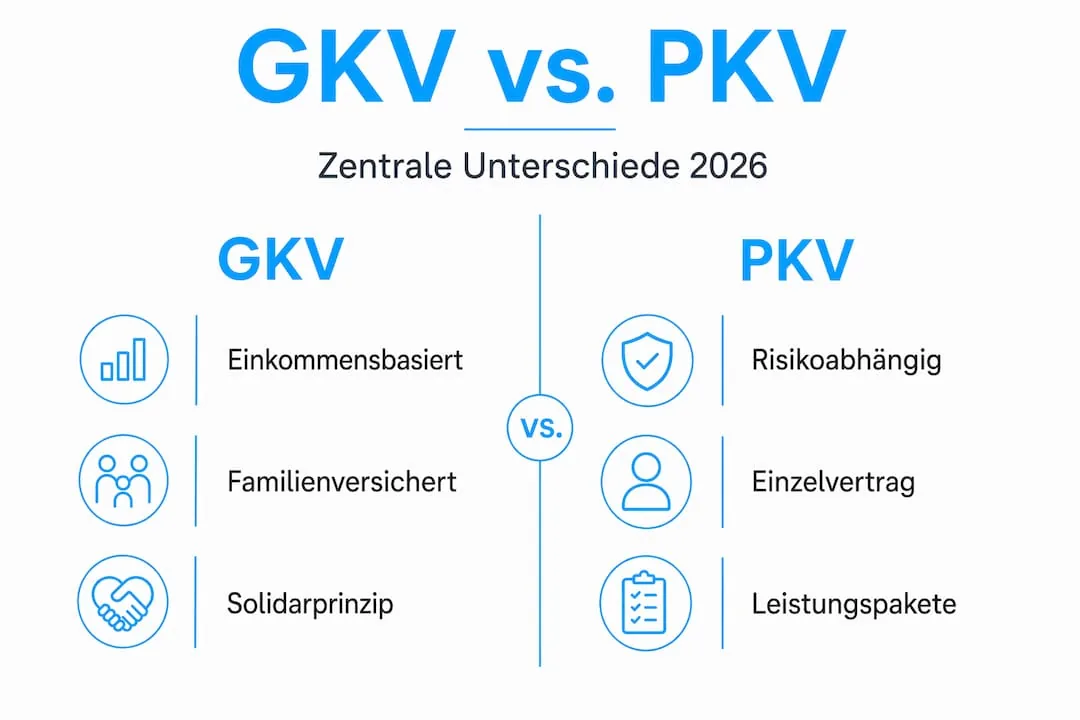
The German health insurance system is built on two pillars: public health insurance (GKV, Gesetzliche Krankenversicherung) and private health insurance (PKV, Private Krankenversicherung). Which one is right for you depends on your income, life situation, and long-term plans.
Want the big-picture overview with a comparison table first? See our guide Health Insurance Germany 2026: GKV vs PKV compared. This page then walks you through the decision step by step.
GKV: Public
- Premium calculated as percentage of income (14.6% + 2.9% additional contribution 2026)
- Employer covers half the cost
- Free family insurance coverage
- Standardized benefit catalog
PKV: Private
- Premium based on age, health status, and selected plan
- Often more comprehensive benefit coverage
- Access from JAEG 77,400 EUR (2026); no income limit if self-employment is your main occupation (artists and publicists: usually KSK) or for civil servants entitled to Beihilfe
- Premiums can increase significantly with age

Key Differences at a Glance
| Feature | GKV (Public) | PKV (Private) |
|---|---|---|
| Premium Calculation | Percentage of income | Based on age, health, plan type |
| Family Coverage | Free family member coverage possible | Each member pays separate premium |
| Benefit Scope | Legally standardized | Individually selectable, often more comprehensive |
| Access | Mandatory for most employees | From JAEG 77,400 EUR or status-based |
| Age-Related Cost Growth | Remains income-dependent | Increases significantly with age |
| Return to Public Insurance | Possible under certain conditions | Rarely possible after age 55 |
The core benefits of public health insurance are legally standardized. The differences among over 90 public health funds are mainly in optional additional benefits and services. Not all funds are available to everyone, as many are limited to specific regions or industries.
Selection Criteria for the Best Health Insurance
Choosing health insurance solely based on the lowest premium rate is a costly mistake. What matters is the value for money. A fund with a slightly higher premium can be significantly cheaper overall through generous bonus programs and statutory benefits.
Bonus Programs and Their Financial Impact
Many public health funds offer bonus programs. Points earned through preventive check-ups, gym membership fees, or vaccination proof can result in hundreds of euros in annual refunds, especially for healthy and active members.
Optional Additional Benefits Overview
| Additional Benefit | Typical Savings / Year | Availability |
|---|---|---|
| Professional Dental Cleaning | 80-150 EUR | Many funds |
| Osteopathy | 200-500 EUR | Selected funds |
| Naturopathy | 100-300 EUR | Some funds |
| Eyeglasses and Contact Lenses | 50-150 EUR | Some funds |
| Sports Programs & Prevention | 150-300 EUR | Many funds |
Other Important Criteria
- Regional Availability: Some funds only operate in certain states.
- Customer Service: Online portal, phone support accessibility, digital document management.
- Optional Plans: Deductible or premium refund options, often with minimum contract periods.
- Specialization: For pre-existing conditions or specific needs, compare carefully.
Pro Tip: Check each fund's statutory benefits directly, as they are transparently listed on each fund's website. A direct comparison of three to five funds quickly shows which one truly offers more.
Compare Health Insurance Now
Free · non-binding · SSL-encrypted
Advertising notice (Affiliate): the comparison is provided by an independent partner. If you sign a contract through it, we may receive a commission (Provision). This does not create any additional cost for you.
The Switching Process: Switch Public Insurance Without Pitfalls
The electronic switching process now makes it possible to switch health funds in less than ten minutes, without needing a cancellation letter. For more details, see our Health Insurance Guide 2026.
Regular Switch: Notice Periods and Process
There is a 12-month binding period from membership start and a 2-month notice period to the end of the month. If you want to switch on January 1, you must submit your application to the new fund by the end of October at the latest.
- Select a New Fund: Compare premiums, benefits, and ratings.
- Submit Membership Application: Online or via form to the new fund.
- Receive Membership Certificate: For your employer.
- Notify Your Employer: So premiums are paid correctly.
- Transition Period: Continuous coverage during the switch.
The Special Right of Termination (Sonderkündigungsrecht)
If your fund increases its additional contribution, you have a special right of termination. Your application to the new fund must be submitted by the last day of the month in which the increase takes effect. The 2-month notice period applies here as well.
Common Mistakes: Late application, missing membership certificate, forgotten optional plan minimum contract period, or missed special termination deadline.
Self-employed individuals and voluntary members may have different rules. An overview of suitable plans can be found at compare health insurance.
Switching from Public to Private Insurance: Opportunities and Risks
Prerequisites
- Employees: Annual gross income must exceed the JAEG (2026: 77,400 EUR).
- Self-Employed & Freelancers: No income limit if self-employment is your main occupation. Exception: self-employed artists and publicists are usually compulsorily insured in public health insurance through the Künstlersozialkasse (KSK).
- Civil Servants: Eligible for state subsidies (Beihilfe).
- Students: Special student private insurance plans available.
Risks You Must Know About
- No Family Insurance: Each family member needs their own policy.
- Premium Adjustments: Private insurers can increase premiums significantly.
- Pre-existing Conditions: Surcharges or coverage exclusions possible.
- Parental Leave / Income Gaps: Private insurance premiums still apply.
Private insurance makes most sense for healthy, well-earning singles without family plans who expect sustained high income. If you are unsure, first compare private insurance plans and calculate scenarios for your later years.
Compare Health Insurance Now and Save
With the insurance comparison on meinetarife24 you will quickly and free of charge find the fund that matches your situation on an independent basis. To save even more, explore our insurance cost optimization section for concrete ways to save significant money annually.
Compare NowFrequently Asked Questions
What is the binding period for switching public health insurance?▾
The binding period for public health insurance (GKV) is 12 months from the start of membership. Additionally, there is a notice period of 2 full calendar months to the end of the month.
When does the special right of termination (Sonderkündigungsrecht) apply?▾
The special right of termination applies when your health insurance fund increases the additional contribution (Zusatzbeitrag). The application with the new fund must be submitted by the last day of the month in which the increase takes effect for this right to be exercised.
How does the electronic health insurance switch work?▾
With the electronic switch, you simply submit a membership application to the new fund. The new fund automatically handles your deregistration with the old fund. A cancellation letter is no longer required, and the process often takes less than ten minutes.
When can you switch to private health insurance?▾
Employees can switch to private health insurance (PKV) if their annual gross income exceeds the annual income threshold (JAEG). In 2026, the JAEG is 77,400 euros. If self-employment is your main occupation, you can choose PKV regardless of income. Exception: self-employed artists and publicists are usually compulsorily insured in public health insurance through the Künstlersozialkasse (KSK). Civil servants entitled to Beihilfe can also choose PKV.
Is switching public health insurance funds really worthwhile?▾
Yes, especially if you want to use additional benefits that your current fund does not offer, or if the additional contribution has increased. Bonus programs and statutory benefits can significantly affect the financial difference between two funds.
Recommended Reading
Sources & Methodology
Our methodology: for this guide, we verified the official 2026 reference figures and switching rules from primary data sources. Contribution rates and thresholds come from official publications; the interpretation comes from independent consumer portals. Data as of June 22, 2026.
- GKV-Spitzenverband (additional contribution and GKV framework)
- Federal Ministry of Health (average additional contribution 2026: 2.9%)
- Finanztip (choosing a fund and the additional contribution)
- Stiftung Warentest (GKV/PKV comparison)
- PKV Association (access to private insurance, JAEG 2026: 77,400 EUR)
All information without warranty. Funds set their own contribution levels.