Compulsory Insurance in GermanyWhat Expats Need to Know in 2026
Compulsory insurance (Versicherungspflicht) covers key areas such as health, long-term care, and pension insurance. This guide helps you understand your obligations as a newcomer and choose the right solution.
In short: Compulsory insurance in Germany requires you to cover certain life risks. The most important obligation is health insurance: everyone living in Germany needs valid health coverage. On top of that come long-term care, pension, unemployment, and accident insurance, plus car liability insurance for every vehicle owner. For expats, proof of health insurance also matters for the residence permit.
Key Takeaways
- Health insurance is mandatory for all residents, statutory (GKV) or private (PKV).
- Social insurance includes health, long-term care, pension, unemployment, and accident insurance.
- Earning above the compulsory insurance threshold of 77,400 euros/year (2026) lets you choose PKV.
- Without proof of insurance you risk back-payments and problems with your residence permit.
Key German Terms
Compulsory Insurance Creates Social Security
The German social insurance system is based on the principle of solidarity. Risks are shared collectively and benefits are distributed fairly. For expats, it is especially important to understand that compulsory insurance covers multiple areas.
What You Need to Know
The essentials about compulsory insurance for expats in Germany.

Compulsory Insurance
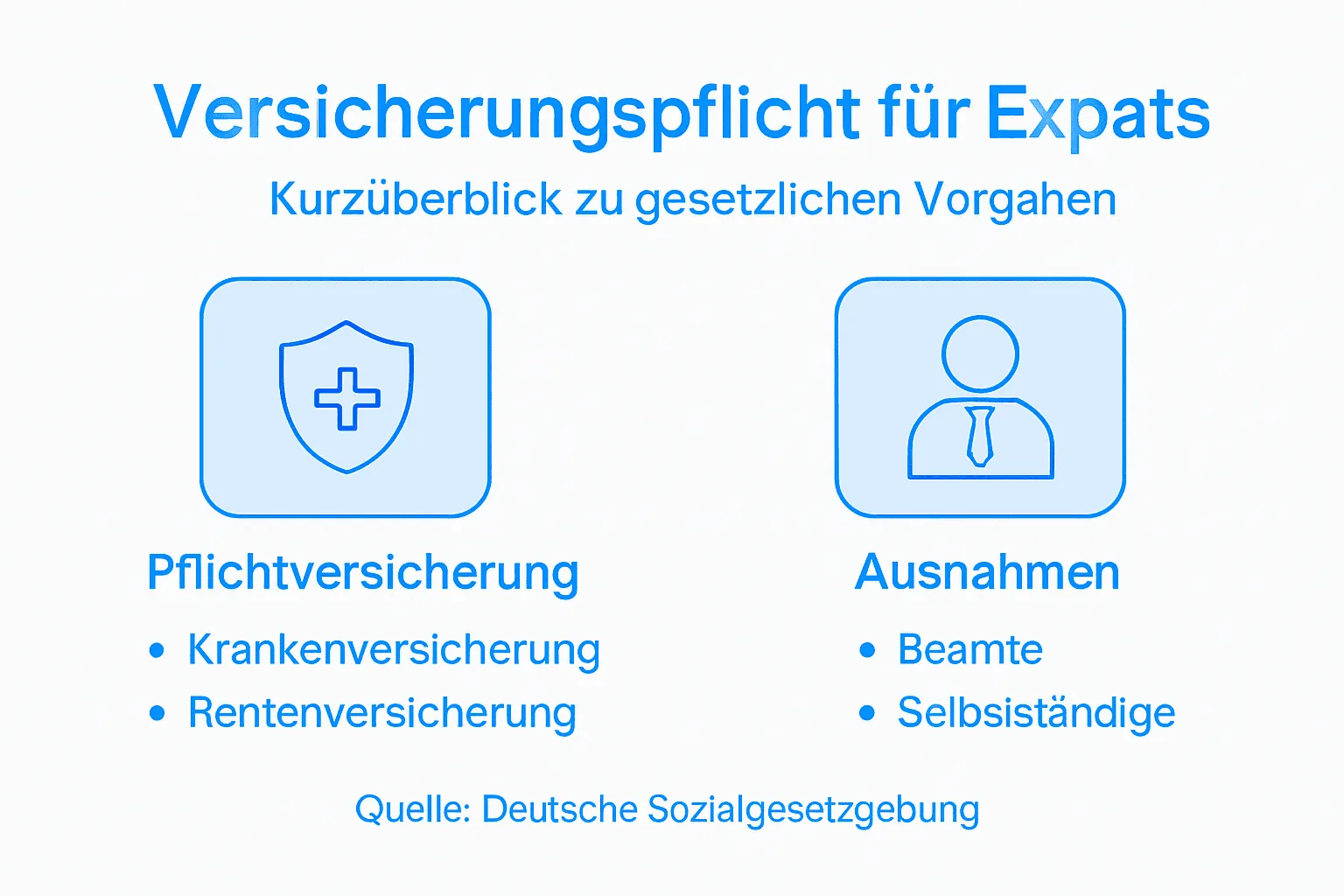
Certain groups are required to insure themselves against life risks.
Mandatory Insurances
Health, pension, unemployment, and long-term care insurance are obligatory.
Exceptions
Civil servants, self-employed, and high earners often have the option for private insurance.
Consequences
Non-compliance can lead to back-payments and consequences for your residence status.
Legally Required Insurances
The German social insurance system includes various mandatory insurances that protect residents against existential risks.
Health Insurance
Mandatory for all residents. Covers medical treatments, medications, and hospital stays.
Pension Insurance
Contribution obligation for employees. Secures retirement and disability benefits.
Unemployment Insurance
Mandatory for employees subject to social insurance. Provides financial support in case of job loss.
Accident Insurance
Protection against occupational accidents and diseases. The employer pays the contributions.
Long-term Care Insurance
Coverage for care services. Mandatory for those with statutory health insurance.
Car Liability Insurance
Mandatory for all vehicle owners. Learn more

GKV or PKV: The Dual Insurance Approach
Germany has a dual system. While public insurance (GKV) applies to the majority, high earners have the option of private insurance (PKV). For a deeper look, see our health insurance comparison.
GKV - Public
Statutory Health Insurance
PKV - Private
Private Health Insurance
Income Thresholds 2026
JAEG (Insurance Threshold)
77,400 Euro/year
Above = can choose PKV
BBG (GKV Contribution Ceiling)
69,750 Euro/year
Max. income for GKV contribution (5,812.50 Euro/month)
2026 figures, source: Federal Government / GKV-Spitzenverband.
Who is Subject to Compulsory Insurance?
Compulsory insurance affects a variety of groups with different professional and social statuses.
Employees
Full-time and part-time employees are subject to compulsory insurance.
Students
Enrolled students at German universities with special rates.
Unemployed
Recipients of unemployment benefits remain subject to compulsory insurance.
Retirees
Persons with statutory pension insurance.
Trainees
Persons in vocational training.
EU Citizens
Special transitional rules for EU nationals.
Consequences of Violating Compulsory Insurance
Non-compliance with compulsory insurance can lead to significant legal and financial consequences.
| Type of Violation | Financial Risks | Legal Consequences |
|---|---|---|
| No health insurance | Back-payment of contributions for the uncovered period | Restricted medical care |
| Non-payment of contributions | Loss of social benefits | Endangerment of residence status |
| False information when enrolling | Repayment demands | Damage claims |
Important for expats: Ignoring compulsory insurance is not an option. The consequences can be existentially threatening and jeopardize your residence status.
Pro Tip for Newcomers
Inform yourself early about your specific insurance obligations as an expat to avoid legal uncertainty and financial risk. Use our free comparison to find the right health insurance for your situation.
Compare Health Insurance
Compare health insurance offers and find the right solution for your compulsory insurance needs. Free and non-binding.
PKV-Vergleich wird geladen...
Sources and Methodology
For this guide we reviewed the official 2026 social insurance figures, the legal basis (SGB V, car liability law), and independent consumer sources. All figures are current as of June 21, 2026, and are checked regularly.
Sources & References(5)
JAEG 77,400 euros, statutory health insurance ceiling 69,750 euros for 2026.
Accessed on: June 21, 2026
Independent breakdown of the 2026 figures.
Accessed on: June 21, 2026
Which insurances are mandatory and which are advisable.
Accessed on: June 21, 2026
Official statutory health insurance figures.
Accessed on: June 21, 2026
Legal basis for health and car liability obligations.
Accessed on: June 21, 2026
meinetarife24 Editorial Team
Our editorial team writes the content and updates it regularly.
Frequently Asked Questions
What is compulsory insurance (Versicherungspflicht) in Germany?
Compulsory insurance means certain groups are legally required to insure themselves against key life risks, above all through health and long-term care insurance. Everyone living in Germany must be able to prove valid health coverage.
Which groups are subject to compulsory insurance?
Mainly employees, students, recipients of unemployment benefits, retirees, and trainees. Voluntarily insured people are included too. Self-employed persons and civil servants follow special rules.
Which insurances are legally required in Germany?
Statutory social insurance covers health, long-term care, pension, unemployment, and accident insurance. In addition, car liability insurance is mandatory for every vehicle owner.
What are the consequences of violating compulsory insurance requirements?
A violation can lead to back-payment of contributions, restricted medical care, and in serious cases problems with your residence permit, because a proof of health insurance is required to renew it.
How high is the compulsory insurance threshold in 2026?
The compulsory insurance threshold (JAEG) is 77,400 euros per year in 2026. Anyone who earns more regularly can choose between statutory and private health insurance. The statutory contribution ceiling (BBG) is around 69,750 euros per year in 2026.
Advertising notice: We work with partners like CHECK24 and Tarifcheck and may receive a commission. The comparison stays free and non-binding for you. Updated: June 21, 2026. This is not legal or financial advice.
Master Compulsory Insurance
Compare plans and fulfill your compulsory insurance requirements with the right solution for your needs.
Compare Now