Gas Price Guarantee in Germany
What It Really Locks
A gas price guarantee sounds like full security, but it does not always keep what the name promises. Here you will learn what a German gas price guarantee actually fixes, what can still rise, and when a fixed price is worth it for you, explained clearly even without prior knowledge of the German energy market.
Key facts at a glance
- A gas price guarantee (Preisgarantie) usually freezes only the unit and base price.
- Taxes, levies, surcharges and often the network charges are excluded and can still rise.
- Check the type: a restricted guarantee protects less than a full one.
- The Gaspreisbremse was a government programme until the end of 2023, not the same as your contract.
Last updated: 7 June 2026 · meinetarife24 Editorial Team · Reading time: approx. 8 minutes
What you will learn
What is a gas price guarantee?
A gas price guarantee, almost always called Preisgarantie in your contract, is your gas provider's promise not to raise certain price components for an agreed term. The provider commits to not increasing the guaranteed price during the guarantee period. This gives you planning security for your monthly costs, especially when energy markets swing sharply.
Such tariffs are sold under names like "price-guarantee tariff" or "fixed-price tariff" and typically run for six to twenty-four months. One point many people miss from the start: a price guarantee does not automatically cover every part of your gas bill. That is the focus of the next section.
Remember: the price guarantee is a civil-law promise and applies only to your individual contract. It is something entirely different from a government programme such as the former Gaspreisbremse.
Restricted vs. full price guarantee
This is the crucial difference that decides the real value of your guarantee. Providers use two basic types:
Restricted price guarantee (eingeschränkt)
Usually fixes only the unit and base price. Taxes, levies, surcharges and often the network charges are excluded and can still change despite the guarantee. This is the most common variant.
Full price guarantee (vollständig)
Covers nearly all price components. Typically only a change in value-added tax (VAT) is excluded. It offers more security but is rarer and often a bit more expensive.
The table below shows which components a typical restricted guarantee protects and which it does not. It helps you read your own gas bill with more confidence.
| Price component | What it is | Covered by guarantee? |
|---|---|---|
| Unit price (Arbeitspreis) | Price per kilowatt-hour (kWh) consumed | Yes, as a rule |
| Base price (Grundpreis) | Fixed annual amount, independent of usage | Depends on the contract |
| Network charges | Cost of using the gas grid | Usually no |
| Taxes & levies | Energy tax, CO₂ levy, gas storage surcharge, etc. | No |
| VAT | Statutory tax rate on the total price | No |
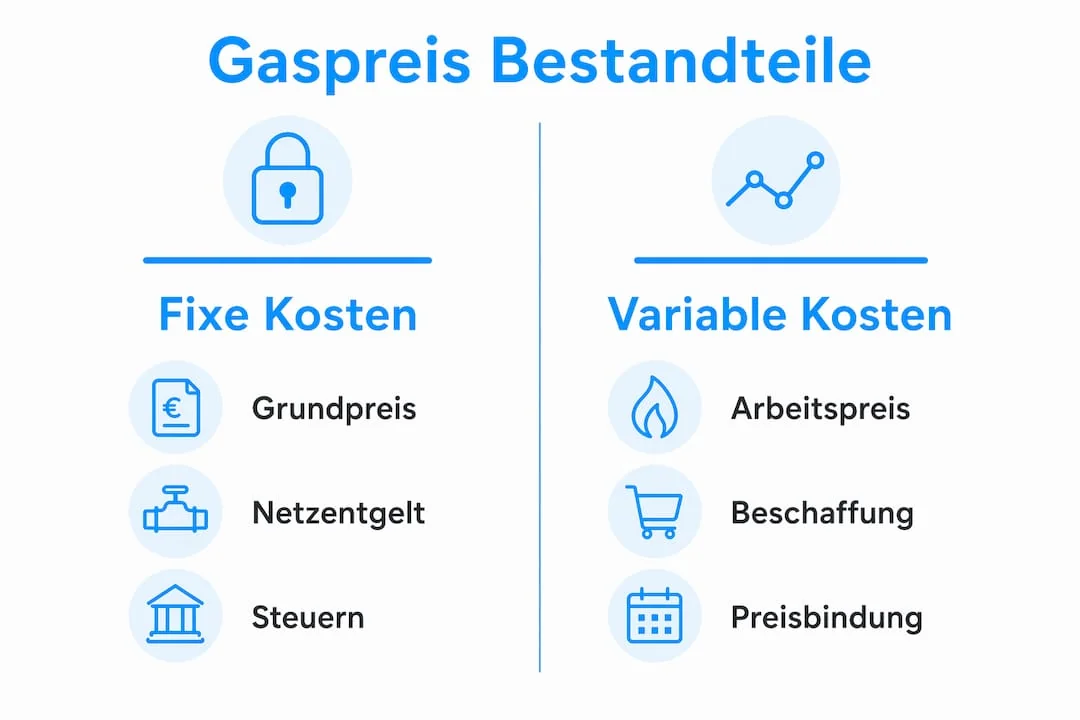
Simplified overview of gas price components (German labels, as they appear on your bill). The exact wording of your contract always prevails.
Compare gas tariffs with a price guarantee
Enter your annual consumption and postal code and compare for free and without obligation. You will see which price-guarantee tariffs fit your usage and your region.
Independent, free comparison. meinetarife24 is funded by provider commissions, at no extra cost to you.
What still rises despite a guarantee?
A price guarantee does not protect you from everything. The state-driven components in particular stay outside it. If the CO₂ levy, the energy tax or a surchargegoes up, the provider may usually pass on that share even while the guarantee runs.
Important: some providers fix only the unit price while raising the base price, if the base price is not expressly included in the guarantee. Read the small print and check whether both the unit and base price are locked.
Price guarantee, fixed price or variable tariff?
Worked example: how strongly the unit price matters
A household using 15,000 kWh per year pays, at a unit price of 8 cents per kWh and a base price of 120 euros a year, a total of 1,320 euros. If the unit price rises to 10 cents without a guarantee, it becomes 1,620 euros. Locking the unit price saves 300 euros a year in this example.
Illustrative figures. Your own result depends on your annual consumption and starting tariff.
Pro tip
Always compare the total price based on your annual usage, not just the unit price. A low unit price with a high base price can be more expensive at low usage than a balanced tariff.
Price guarantee vs. Gaspreisbremse
The two terms are often confused but mean completely different things. The Gaspreisbremse (gas price brake) was a government relief programme introduced in response to the energy crisis. It capped the price at 12 cents per kWh (gross) for around 80 percent of the forecast prior-year consumption and ran until the end of 2023. Its legal basis was the Erdgas-Wärme-Preisbremsengesetz, financed through the Economic Stabilisation Fund. This programme has expired.
| Feature | Price guarantee | Gaspreisbremse |
|---|---|---|
| Origin | Contract with the provider | Government law |
| Who benefits | Only your contract | All gas customers |
| Duration | Contractual, e.g. 12 or 24 months | Temporary, ran until end of 2023 |
| Currently valid? | Yes, depending on contract | No, expired |
In short: government relief does not replace contractual protection. If you want planning security, look at your own contract. An independent take on rising gas prices is also published by Stiftung Warentest, Germany's independent consumer foundation. The Bundesnetzagentur (Federal Network Agency) publishes current gas prices and supplier-switch rules, and the Verbraucherzentrale (consumer advice centre) explains what to check in the fine print of a price guarantee.
Who it suits and what to do when it expires
A price guarantee is most worthwhile for high-consumption households, such as families heating with gas. With very low consumption a high base price can cancel out the benefit, so flexible tariffs without a long minimum term are often the better choice.
The follow-on tariff trap
If your guarantee expires and you do nothing, you often slide automatically into a more expensive follow-on or basic-supply tariff. Set a reminder a few months before it ends.
How to act when it expires
Good to know: the 24-hour rule for the technical supplier switch, in force since 6 June 2025, applies only to electricity, not gas. Your contractual notice period is unaffected in any case.
For expats and newcomers
German energy contract law is complex, and terms like Grundversorgung (basic supply), Sonderkündigungsrecht (special right to cancel) or eingeschränkte Preisgarantie (restricted price guarantee) are hard to judge without prior knowledge. If you have just moved to Germany, remember: a price guarantee is helpful but not a blank cheque. Always check whether the unit and base price are locked and which state-driven parts stay outside it.
meinetarife24 explains these topics in German, English and Turkish so you can make an informed decision, even if German is not your first language.
Frequently asked questions
Related articles
Compare gas tariffs (expat guide)
How to compare German gas tariffs and find one with a suitable price guarantee.
Gas basic supply (Grundversorgung)
Why you are enrolled automatically, what it costs and how to switch without a Schufa.
Types of gas tariffs
Basic supply, fixed price, price guarantee, eco-gas and volume packages explained.
Find a tariff with a price guarantee
Compare for free and without obligation and find the gas tariff that fits your usage and your need for security.
Free · Independent · SSL-encrypted