
In a nutshell
Insurance conditions consist of General (AVB) and Special Insurance Conditions (BVB). The BVB define your specific tariff and take precedence over the AVB in case of conflict. They only become legally effective if the insurer clearly refers to them under BGB § 305 and VVG § 7. Read the exclusions and obligations especially carefully.
Key takeaways
| Point | Details |
|---|---|
| AVB as framework | Standardised rights, duties and exclusions for all contracts of a product type. |
| BVB take precedence | They define the individual tariff and override the AVB in case of conflict. |
| Legal inclusion | Under BGB § 305 and VVG § 7 the insurer must refer to them clearly, otherwise they do not apply. |
| Mind your obligations | Late claim notifications can jeopardise your cover. |
Table of contents
What are insurance conditions?
Insurance conditions (Versicherungsbedingungen) are the written contract rules that set out the exact content, rights, duties and scope of cover. They form the legal basis of every insurance relationship in Germany and determine when and to what extent an insurer pays.
They are made up of two document types: the General Insurance Conditions (AVB) and the Special Insurance Conditions (BVB). Together they define the contract and protect both policyholder and insurer against misunderstandings. The exact wording decides, in a claim, whether and how much the insurer pays.
AVB and BVB compared
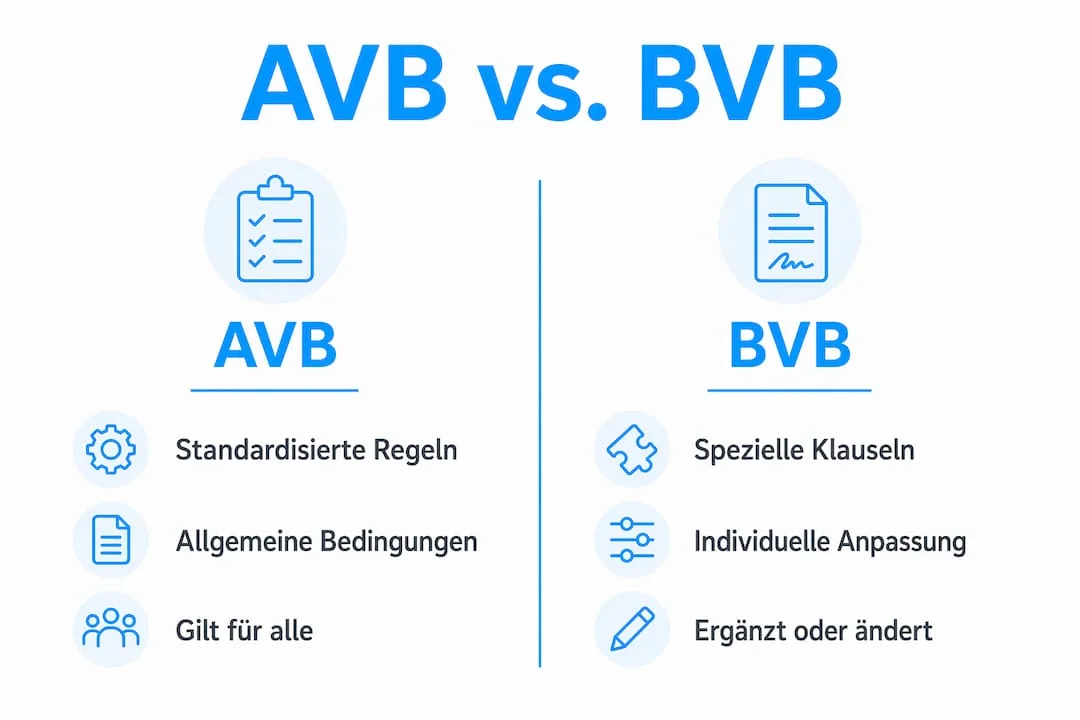
The AVB are standardised, legally binding framework conditions that an insurer uses uniformly for a given insurance type – for example all motor liability or all home contents policies of a provider. They define the insured event, the scope of cover, exclusions and the rights and duties of both parties.
The BVB are deviations from or additions to the AVB and can widen or narrow cover. A key point many people miss: the BVB define the individual tariff and take precedence over the AVB in case of doubt. Example: a home contents policy may exclude bicycle theft in the AVB, while the BVB of a specific tariff include it again for a surcharge.
| Feature | AVB | BVB |
|---|---|---|
| Scope | Uniform for all contracts of a product type | Individual to a specific tariff |
| Function | Framework for the cover | Addition to or deviation from the AVB |
| Precedence | Acts as the basis | Overrides AVB in case of conflict |
| Example | Exclusion of intentional damage | Inclusion of bicycle theft for a surcharge |
Pro tip
With every new contract, read the BVB first, before the AVB. The BVB determine what your specific tariff actually delivers – the AVB only provide the general framework.
When do insurance conditions become legally effective?
Merely existing does not make conditions part of the contract. For AVB to be legally included, the requirements of the Civil Code (BGB) and the Insurance Contract Act (VVG) must be met:
- 1Clear reference (BGB § 305 (2)): The insurer must explicitly refer to the AVB when the contract is concluded. A hidden reference in the small print is not enough.
- 2Reasonable opportunity to read them: The conditions must be legible, understandable and accessible.
- 3Consent: The policyholder must agree to the AVB applying – usually by signing the application.
- 4Written information (VVG § 7): The insurer must inform the policyholder in good time, in text form, clearly and understandably, before the contract is concluded.
- 5Catching up in distance selling: For online or phone contracts the written information may be provided later under certain conditions, e.g. immediately after conclusion.
Important in a dispute
If an insurer does not meet these requirements, the AVB do not become part of the contract – the clauses in question then do not apply. So keep every document you received before or at the conclusion of the contract.
What do insurance conditions actually regulate?
Insurance conditions follow a clear structure and govern four core areas:
Rights and duties
Which rights the policyholder has (e.g. payment in a claim) and which duties they must meet – plus the insurer's duties to pay and to inform.
Scope of cover
Which events are covered and at what level – for fully comprehensive car insurance, e.g. accident, vandalism, natural events.
Exclusions
Clauses that exclude certain losses (e.g. war, nuclear energy, intent). This is where policyholders get the biggest surprises.
Start, term, cancellation
Many contracts renew automatically for a year. Car insurance usually has a one-month notice period to year-end.

Obligations (Obliegenheiten): duties with consequences
Obligations are duties of conduct; ignoring them can jeopardise your cover. Typical ones are:
- Notifying the insured event promptly, within the deadline
- Giving truthful information in the claim
- The duty to mitigate the loss
- Allowing the insurer to investigate
Compare liability tariffs and their conditions
Personal liability insurance is the most important basic cover for many people. Compare tariffs for free here – and look not only at the price but also at the cover sum and exclusions.
Loading Liability Calculator...
Please wait a moment
Independent, free comparison. meinetarife24 is financed through provider commissions, at no extra cost to you.
Reading and applying conditions the right way
The texts are often long and written in legal language. Reading them carefully before signing is nonetheless essential. These steps help:
- Read the BVB first: they determine what your specific tariff actually delivers.
- Look for exclusions: sections titled “Exclusions" or “Risks not covered" are often decisive.
- Note your obligations: especially notification deadlines and conduct rules in a claim.
- Use the product information sheet: it summarises the key points and makes comparison easier.
- Compare conditions: differences in cover are often bigger than price differences – see comparing insurance offers.
When is legal advice worthwhile?
When the insurer rejects a claim and you believe the loss should be covered. Consumer advice centres and the Bund der Versicherten (BdV) offer initial guidance; the Insurance Ombudsman is a free out-of-court arbitration body. For larger amounts in dispute, a lawyer specialised in insurance law can help.
Notes for newcomers to Germany
For expats and new arrivals, insurance conditions are a double hurdle: legal language and a foreign language at once. Don't be put off – the key terms are manageable, and a multilingual portal like meinetarife24 (German, English, Turkish) helps you get started.
Tip: focus first on scope of cover, exclusions and obligations. These three almost always decide, in a claim, between success and rejection.
Compare insurance properly
Compare not just prices but contract details too. All comparisons are free, without obligation and available in several languages.
Frequently asked questions
What exactly are insurance conditions?
The written contract rules that set out the rights, duties, scope of cover and exclusions of an insurance contract. They consist of General (AVB) and Special Insurance Conditions (BVB).
What is the difference between AVB and BVB?
AVB are standardised framework conditions for all contracts of an insurance type; BVB are individual additions or deviations for a specific tariff. In case of conflict the BVB take precedence.
When do insurance conditions become legally effective?
Under BGB § 305 only if the insurer clearly refers to them when the contract is concluded and the policyholder had a reasonable opportunity to take note of them.
What happens if I do not meet my obligations?
Failing to meet obligations, such as a late claim notification, can lead to partial or total loss of cover. Keep to all deadlines and duties stated in your conditions.
How do I compare conditions of different insurers?
Use the product information sheet for a first overview, then read the BVB of each tariff. Comparison portals like meinetarife24 make it easier to compare scope of cover and exclusions.
Key German Terms
Versicherungsbedingungen
Insurance terms & conditions
AVB
General terms (Allgemeine V.)
BVB
Special terms (Besondere V.)
Versicherungsnehmer
Policyholder
Leistungsumfang
Scope of cover
Ausschlüsse
Exclusions
Obliegenheiten
Policyholder duties
Produktinformationsblatt
Product info sheet