Why Transparent Tariff Choice Really Matters
When you search for a new electricity, gas or insurance tariff in Germany, most people look at the lowest price first. That is understandable — but often the most expensive mistake. Real tariff transparency is what protects you from hidden costs and unexpected back-payments.
Key takeaways
- Tariff transparency protects you from cost traps. Only when you know every price component can you really compare tariffs and avoid expensive surprises.
- Check working price and base price together. In German energy tariffs both components together determine annual cost, not the kWh price alone.
- Read price guarantees carefully. Many guarantees do not cover every component. Taxes and statutory levies are often excluded.
- Weigh up Wahltarife in statutory health insurance. Premium refunds sound attractive but come with strict conditions and lock-in periods.
- Adjust comparison-portal filters actively. Default filters on comparison portals significantly influence what you see in the results list.
Why transparent tariff choice is the key
Tariff transparency means that all relevant price components, conditions and limitations of an offer are communicated clearly and completely. It is not just about whether a price looks low — it is about whether you, as a consumer, really understand what you are paying for.
In day-to-day life that transparency is often missing. Providers advertise attractive working prices per kilowatt-hour without prominently disclosing the monthly base price. Insurers highlight bonuses without explaining the conditions under which they pay out.
What tariff transparency actually covers
For a tariff offer to be truly transparent, the following information must be available completely and understandably:
All price components
For energy tariffs this includes the working price (per kWh), the base price (monthly fixed fee) as well as grid fees and taxes.
Contract term and notice period
How long are you tied in? Does the contract renew automatically?
Scope of any price guarantee
Which parts of the price are actually guaranteed, and for what period?
Conditions for bonuses and refunds
When do you actually receive a bonus, and what disqualifies you from it?
Payment terms
Are there surcharges for certain payment methods such as prepayment or direct debit?
The impact of missing transparency is measurable. If you choose an electricity tariff purely on the working price, you can end up paying more per year than with a tariff that has a higher kWh price but a lower base price. It depends entirely on your own consumption profile. Our German electricity price guide shows how working price and base price interact in the annual bill — and helps you avoid bad decisions.
A practical example from health insurance: a statutory health insurer (gesetzliche Krankenkasse) advertises a Wahltarif with an attractive premium refund. If you do not read the conditions, you may only notice after a year that a single doctor visit cancels the entire refund.
Energy tariffs: understanding price components
Electricity and gas are areas where opaque tariffs especially often lead to surprise back-payments. The reason lies in the structure of price components that many consumers do not fully understand.
Working price and base price: two numbers, one bill
The annual cost of an energy tariff always comes from two components. The working price (cent per kWh) is multiplied by your actual consumption. The base price is a monthly fixed fee that applies regardless of consumption. Only both components together determine the annual cost — isolated kWh prices are misleading.

For a single-person household with 1,500 kWh per year, a tariff with a low working price and high base price can be more expensive than one with a higher working price and lower base price. For a family of four with 4,500 kWh per year, that ratio often flips. Break-even analyses based on your own consumption profile are therefore essential.
Price guarantees: what they really cover
Many energy tariffs advertise 12- or 24-month price guarantees. But those guarantees often do not cover every component. Taxes, statutory levies and grid fees are usually excluded. That means: if those items rise, you still pay more despite the guarantee.
The legal basis for this is unambiguous. Providers are allowed to exclude state-influenced price components from a price guarantee. Anyone who does not know this is in for an unpleasant surprise.
Checklist: what to watch out for in energy tariffs
Before you sign an electricity or gas contract, check the following points, in this order:
- Calculate annual cost: working price × your annual consumption + base price × 12 months. Only this number is meaningful.
- Read the price guarantee carefully: which components are guaranteed? Does the guarantee cover working price, base price or both?
- Check term and notice: how long does the contract run? Does it renew automatically — and if so, for how long?
- Evaluate new-customer or switch bonus: is the bonus credited immediately or only after 12 months? What are the conditions?
- Clarify payment terms: according to Stiftung Warentest, term, kWh price and price guarantee should always be checked before switching.
| Criterion | What to check | Typical pitfall |
|---|---|---|
| Working price | Cent per kWh, multiplied by your consumption | Comparing without your own consumption |
| Base price | Monthly fixed fee, times 12 | Often printed in small text |
| Price guarantee | Which components, for how long | Levies often excluded |
| Contract term | Months, automatic renewal | Renewal by 12 months |
| Bonus | Conditions, payout timing | Bonus claw-back on early switch |
Pro tip: When you use the gas tariff comparison, enter your actual annual consumption — not the pre-filled default. The default often does not match your profile and skews the result significantly.
Insurance tariffs: Wahltarife and their conditions
In health insurance — especially in the statutory system (gesetzliche Krankenversicherung) — one tariff category is misunderstood particularly often: the Wahltarife (optional tariffs).
What Wahltarife promise
Wahltarife allow statutory-insured people to gain financial advantages in exchange for certain commitments. The best-known case is the premium refund: if you claim few or no services during a year, you receive part of your contribution back at year end.
That sounds attractive. The reality is more complex. Premium refunds are capped at one monthly contribution at most and depend on individual income. Preventive check-ups are typically not counted as an exception — even though they belong to the statutory benefit catalogue. Our Krankenversicherung switching guide 2026 explains how to evaluate the conditions.
Concretely: if your only use of services in a year is the annual check-up, you still receive no refund. The fund counts that use as benefit consumption.
Weighing the risks
Experts sometimes describe Wahltarife as a bet on your own health. Stay healthy, and you benefit. Fall ill, and the financial advantage disappears — you still pay the regular premium without refund.
In addition, trigger conditions and lock-in periods matter. Many Wahltarife bind you to the fund for three years. During that time you cannot switch funds — not even if the contribution rate goes up.
Pro tip: When comparing health insurers, look not only at extra benefits but also at the current additional contribution (Zusatzbeitrag) and how it has developed over the last three years. A fund that raises its contribution regularly can be more expensive overall — despite an attractive Wahltarif.
For insurance Wahltarife, always check these points:
- Trigger conditions: what counts as use of benefits? Does preventive care count?
- Lock-in: how long are you obliged to stay with the fund?
- Maximum refund: what is the possible amount, and which factors drive it?
- Contribution history: has the fund raised the Zusatzbeitrag often in recent years?
- Exclusions: which services are restricted or excluded in the Wahltarif?
Transparency on Wahltarife protects you from false expectations and unpleasant surprises after signing.
Practical tips for choosing a tariff
Knowing about tariff transparency is good. Applying that knowledge is better. This section gives you concrete tools that make your next tariff decision noticeably safer.
Using comparison portals correctly
Comparison portals are a useful tool, but not a neutral one. Default filters for price guarantee, payment method or contract term influence the results significantly. If you do not actively adjust those settings, you may not see all relevant offers. Our detailed overview of German electricity comparison portals explains how the rankings work.
A real-world example: a portal sets the payment method to "direct debit" by default. If you prefer prepayment, you may not even see potentially cheaper tariffs because that option is filtered out. Accurate and timely information matters more than mere data volume. Check and adjust the filter settings consciously on every comparison.
Comparison: transparent vs. opaque tariffs
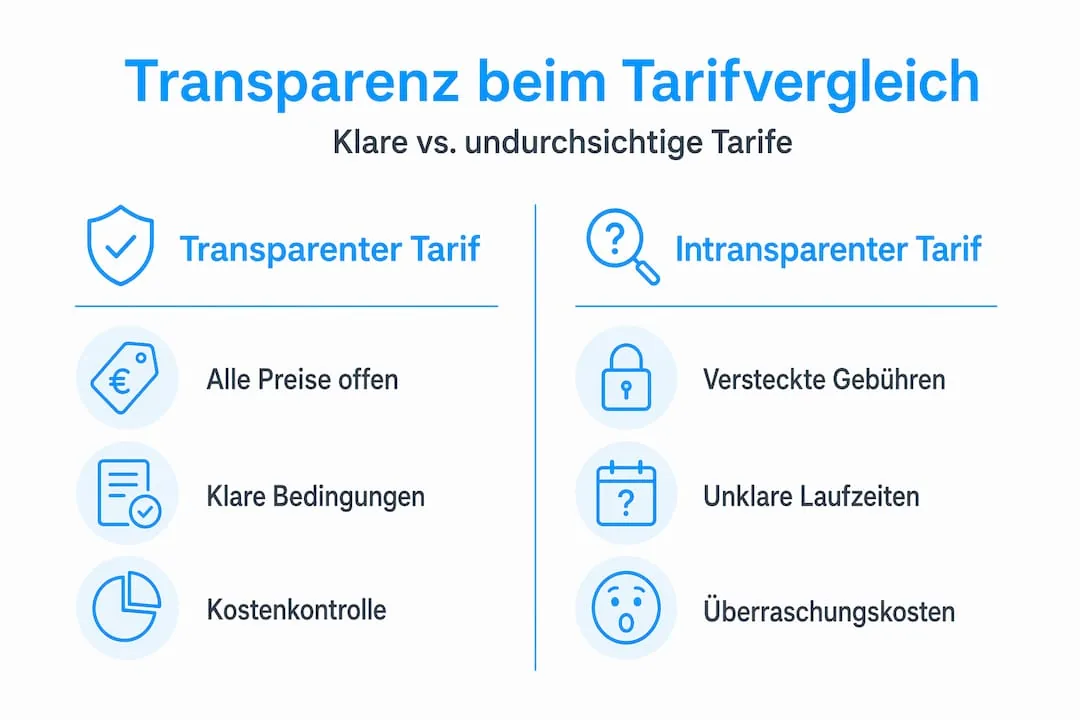
| Feature | Transparent tariff | Opaque tariff |
|---|---|---|
| Price presentation | Working price and base price clearly separated | Only working price advertised |
| Price guarantee | All covered components clearly named | "Price guarantee" with no scope detail |
| Bonus conditions | Fully and understandably explained | Hidden in the fine print |
| Contract term | Stated clearly in the offer | Hard to find |
| Payment methods | No surcharges or clearly disclosed | Surcharges only at checkout |
Pro tip: In the electricity comparison, always sort tariffs by total annual cost — not by working price. That gives you the most honest picture of what you will actually pay.
Use your consumption profile as the basis
Do you know your annual consumption? That is the single most important number for any tariff decision. You will find it on your last annual bill. For electricity, the average consumption of a single-person household is about 1,500 kWh; a family of four uses roughly 4,000 to 5,000 kWh per year.
Clear checklists make tariff decisions significantly easier. The following checklist helps with any tariff review:
- Note your annual consumption from the last bill
- Always have offers calculated on your own consumption
- Check the price guarantee for covered components
- Read the contract term and renewal rules
- Fully understand bonus conditions before switching
- Compare payment methods and factor in any surcharges
- For insurance: research the last three years of contribution history
An often-overlooked aspect is automatic contract renewal. Many tariffs renew for another twelve months if you do not cancel in time. The notice period is often six weeks before the contract end. Miss that and you are tied for another year, frequently on worse terms.
Editorial take on tariff transparency
by yasin
I have worked with consumer questions around energy, insurance and financial products for years. And again and again I see the same pattern: people sign contracts without really understanding the conditions, and they pay for it — literally.
That is not a consumer failure. It is the result of a system that rewards opacity. Providers know that most people do not have time to read all the fine print. That is why the price guarantee is such a good example. It sounds like security, but it is often an empty shell.
What still surprises me after all these years is how few people know their own annual consumption. That is the number without which no tariff comparison makes sense. With the right consumption value and a few simple questions about price guarantee, term and bonus, a tariff can be assessed seriously in ten minutes.
My advice: do not trust any offer that does not immediately and clearly show what you will pay across the year. If they do not show that, they have something to hide. Transparency is not an extra service. It is the minimum you are allowed to demand as a consumer.
— yasin
How meinetarife24 supports your tariff choice
Finding transparent tariff comparisons for energy, insurance and financial products in one place is not a given. meinetarife24 is built exactly for that.
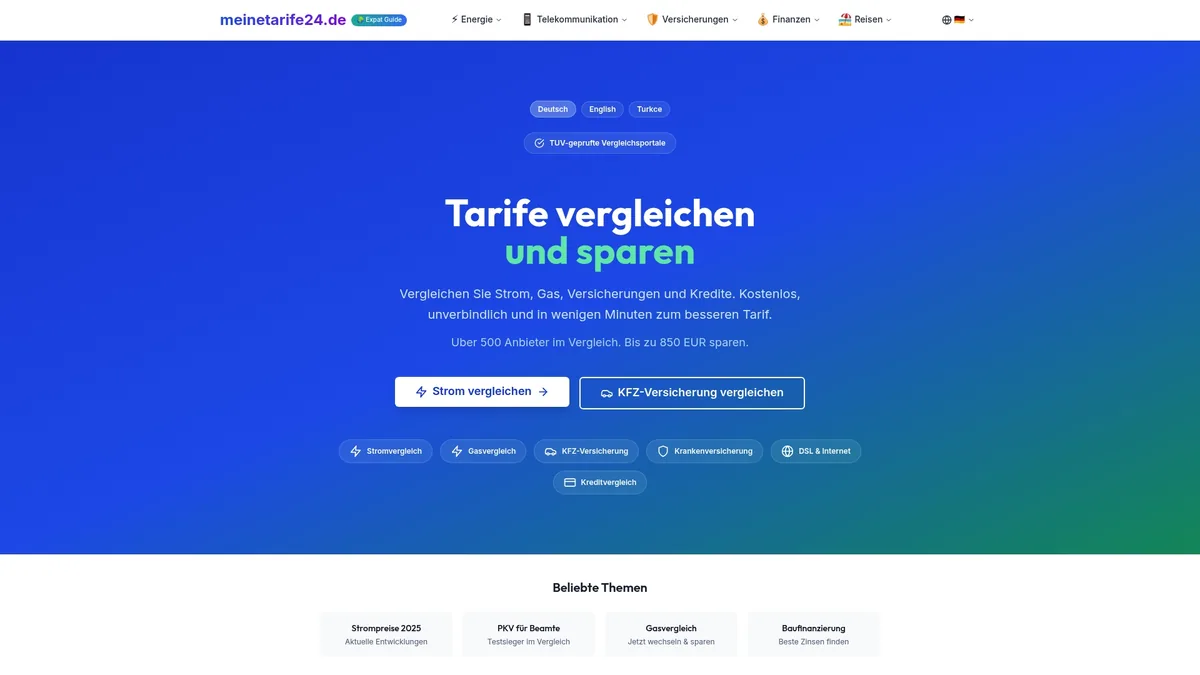
On meinetarife24.de you can compare electricity and gas tariffs using your own consumption data, contrast insurance offers and review financial products. Results are presented clearly — including annual cost, price guarantees and contract terms. All comparisons are free, and data processing is GDPR-compliant. The platform is available in German, English and Turkish, which makes it accessible for expats and international professionals.
Savings of up to EUR 850 per year are possible when you select the right tariffs based on your own profile.
Frequently asked questions
What does tariff transparency actually mean?
Tariff transparency means that all price components, conditions and limitations of an offer are presented completely and understandably. For energy this includes the working price (per kWh), the base price (monthly fee) and the scope of any price guarantee.
Why is comparing the working price alone not enough?
The working price alone is not meaningful because the monthly base price has a significant impact on annual costs. Both values together produce the real total cost.
Are price guarantees on German energy tariffs reliable?
Not entirely. Price guarantees usually do not cover every component. Taxes, grid fees and statutory levies are typically excluded and can still rise.
Who benefits from optional tariffs (Wahltarife) of statutory health insurers?
Optional tariffs (Wahltarife) primarily benefit young, healthy insured who barely use medical services. If you have regular doctor visits or preventive check-ups, read the conditions carefully — even preventive check-ups can disqualify you from the refund.
How do default filters on comparison portals affect results?
Default filters such as payment method or price-guarantee duration on comparison portals can hide relevant tariffs. Adjust filters manually to fit your profile to get complete, honest results.
Compare tariffs transparently
Now you know the key levers. Compare your tariffs with full price components and save up to EUR 850 per year — with no hidden costs.