In a nutshell
Energy providers supply households with electricity, gas or district heating and handle the contract, purchasing and billing. The grid operator (Netzbetreiber) runs the infrastructure and stays independent. You can choose the provider freely, but not the grid operator. Comparing tariffs regularly quickly saves an average household several hundred euros a year.
Key takeaways
| Point | Details |
|---|---|
| Market structure | Providers supply energy, grid operators run the infrastructure – strictly separated. |
| Free provider choice | You choose the provider freely, but not the grid operator – it is tied to your location. |
| Check green electricity | The term is unprotected – labels like Grüner Strom Label or OK-Power give certainty. |
| Switching is easy | Digital, two to four weeks, no supply gap – the portal does most of the work. |
Table of contents
What does an energy provider do?
Energy providers – technically energy suppliers or energy supply companies (EVU) – supply households and businesses with electricity, gas or district heating and handle the contract, customer service and billing. They sit at the interface between energy producers, grid operators and end customers.
Their core task is not running lines or meters, but buying energy on wholesale markets and reselling it to end customers. This separation of supply and grid infrastructure has been enshrined in law since the liberalisation of the German energy market in the 1990s. Germany has a large number of energy suppliers – competition is real, and consumers genuinely have a choice.
For private customers, the role of electricity providers matters because they decide on tariffs, terms and cancellation periods. The provider sets the price you pay and the extras your contract includes – yet many consumers still make too little use of this freedom of choice.
What tasks does an energy provider handle?

- Energy purchasing and trading: electricity and gas are bought on the exchange (e.g. EPEX SPOT) or via long-term contracts. The purchase price directly affects the end price.
- Contract and supply obligation: the provider concludes the supply contract and delivers the agreed amount of energy.
- Billing: annual bills are based on the meter data from the metering operator.
- Customer service: questions about bills, moving home and tariff switches are handled by the provider – not the grid operator.
- Working with grid operators: supply volumes are reported and balanced via balancing groups.
Worth knowing: the electricity price is made up of the energy price, grid fees and levies. A large part is regulated and outside the provider’s control – only the energy share itself is competitive and therefore negotiable.
Pro tip
Report a fault on the line or meter directly to your regional grid operator – not the electricity provider. The provider handles contract matters, the grid operator handles the infrastructure.
Energy provider vs. grid operator – the difference
Many consumers ask this, especially when a bill arrives or a fault occurs. The answer is clear: providers and grid operators are strictly separated. You choose the provider freely, but not the grid operator – this separation is required by law and protects competition.
| Feature | Energy provider | Grid operator |
|---|---|---|
| Task | Energy supply and contract | Running and expanding the grid |
| Can you choose? | Freely chosen | Location-bound, no switch |
| Faults | Not responsible | Responsible |
| Market | Competitive market | Regulated monopoly |
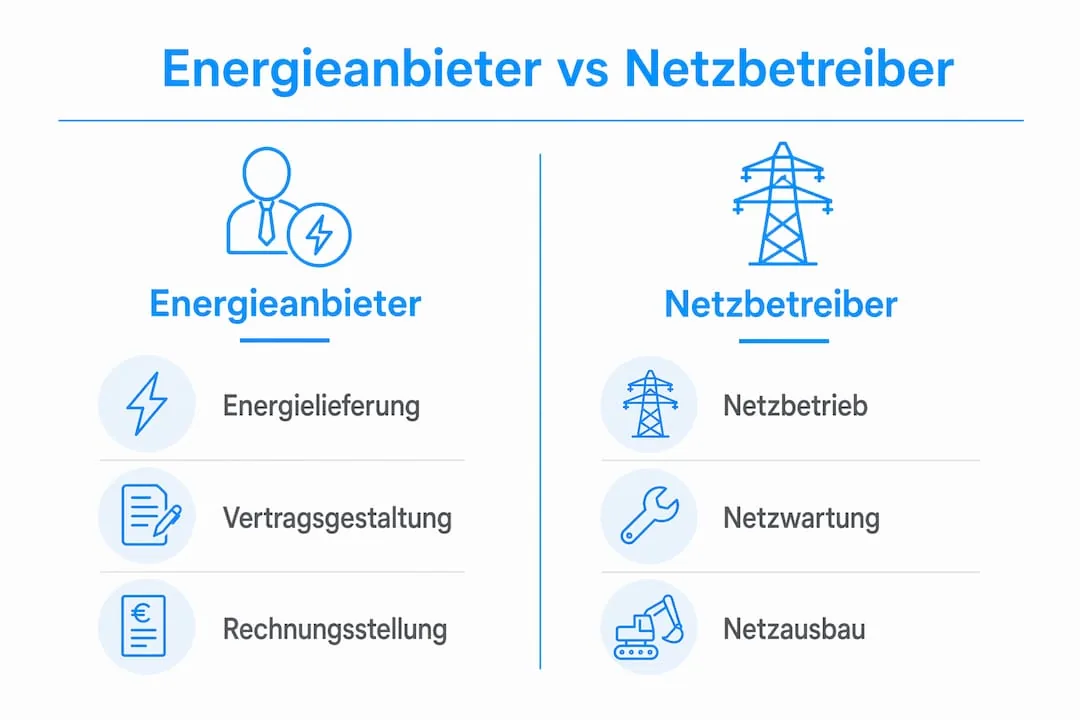
Whichever electricity provider you choose, the lines in your home always belong to the same regional grid operator. That is why switching provider has no effect on physical supply security. A third player is the metering operator (Messstellenbetreiber), who installs and runs the meters, especially modern smart meters. This three-way split explains why different bills can come from different companies.
Compare providers directly: electricity
Enter your postcode and annual consumption and compare the offers of many providers for free and without obligation. In a few minutes you will see which tariff fits your household.
Independent, free comparison. meinetarife24 is financed through provider commissions, at no extra cost to you.
What tariff types do energy providers offer?
Comparing pays off because price differences are substantial: default basic-supply tariffs are usually much more expensive than the special tariffs of alternative providers. For an average household using around 3,500 kWh a year, that quickly adds up to several hundred euros annually.
- 1Basic supply tariff: automatic with the local default supplier, no minimum term and immediately available (e.g. after moving) – but more expensive.
- 2Special tariff: cheaper, with a price guarantee and usually a one- to two-year term – often the most attractive option for new customers.
- 3Green tariff: electricity from renewables, often with a quality label – often comparable in price to conventional tariffs.
- 4Dynamic tariff: since 2025 every provider must offer at least one – linked to the exchange price, ideal with a smart meter and flexible consumption.
- 5Combined electricity & gas: both products bundled into one package price with a discount.
Pro tip
With special tariffs, check the price guarantee: some providers only guarantee the unit price, not the base price. And look critically at new-customer bonuses – high bonuses can hide an expensive follow-on tariff.
Spotting real green electricity vs greenwashing
Providers that actively invest in new renewable plants make a measurable contribution to the energy transition. Those that merely buy certificates without creating new capacity contribute little to real decarbonisation. Here is how to tell genuine green electricity from greenwashing:
- Check quality labels: “green electricity” is not legally protected. Reliable ones are Grüner Strom Label and OK-Power, awarded independently.
- Understand certificates of origin: every provider must disclose its energy mix – a high renewable share is good but, on its own, no proof of real sustainability.
- Investment in new plants: providers that invest directly in new wind and solar make the decisive difference versus pure certificate trading.
- Regional generation: electricity from regional sources strengthens local value creation and supply security.
The heating transition is reshaping many providers’ business models: the shift from gas heating to heat pumps and rising demand for green electricity put the sector under pressure. Choosing a future-proof provider today pays off in the long run.
Choosing the right provider and tariff
Choosing a provider is not a one-off – it is a process you should repeat regularly. Switching is mostly digital, via comparison portals – easier than many think. What to look at:
- Compare unit price (ct/kWh) and base price (€/month) separately
- Note the duration of the price guarantee
- Short terms (12 months) for more flexibility
- Check customer reviews on service quality
- Quality labels if sustainability matters
- Look critically at high bonuses – an expensive base tariff often follows
The switch itself is straightforward: you sign up online, the new provider cancels the old contract and coordinates the switch with the grid operator. Your supply is not interrupted during the switch; the process usually takes two to four weeks. A common mistake is to stop comparing after switching. Check once a year and you stay cheap for good.
Compare providers and tariffs now
Compare for free and without obligation. All comparisons are available in several languages – especially helpful for expats and newcomers.
Frequently asked questions
What is the job of an energy provider?
An energy provider supplies electricity, gas or district heating, concludes supply contracts and handles billing and customer service. It buys energy on wholesale markets and delivers it through the grid operator’s network to the end customer.
What is the difference between an energy provider and a grid operator?
The energy provider supplies the energy and shapes the contract; the grid operator runs the lines and is responsible for faults. You can choose your provider freely, but not the grid operator, which is tied to your location.
How much can I save by switching provider?
Moving from the default basic supply to a cheaper tariff often saves an average household several hundred euros a year. With a dynamic tariff and a smart meter, further savings are possible depending on your consumption.
How do I recognise a genuine green electricity tariff?
The term “green electricity” is not legally protected. Look for independent labels such as Grüner Strom Label or OK-Power – they confirm the provider actually invests in new renewable plants.
How long does a provider switch take?
Usually two to four weeks, fully digital. The new provider cancels the old contract; your electricity supply is not interrupted during the switch.
Key German Terms
Energieanbieter
Energy provider / supplier
Netzbetreiber
Grid operator
Messstellenbetreiber
Metering operator
Grundversorgung
Default basic supply
Arbeitspreis
Unit price (ct/kWh)
Grundpreis
Base price (€/month)
Ökostrom
Green electricity
Dynamischer Tarif
Dynamic tariff