Why Online Comparison Really Matters in 2026
When you search for a new electricity, mobile or insurance tariff in Germany today, you face hundreds of offers that look almost identical at first glance. New legal duties, more complex tariff structures and changing market mechanics make a well-informed comparison strategy more important than ever.
Key takeaways
- Price is not everything. Quality, flexibility and contract conditions matter at least as much as the headline price.
- New rights protect you. § 312i BGB obliges providers since March 2026 to offer more transparency and user-friendly purchase flows.
- Discounts can mislead. In 77 % of discount campaigns the reference price is unrealistically high, leading consumers to pay about 13 % more than the cheapest real alternative.
- Local network quality decides. Headline mobile data rates rarely apply at your home address or workplace.
- Comparison portals have limits. Best-price clauses and covert ranking influence restrict the neutrality of some portals.
Basics of online comparison tools 2026
Online comparison portals collect tariff data from many providers, process it and present it to the user — filtered and sorted. That sounds simple. In practice it sits on a layered system of data sources, ranking algorithms and partnership agreements.
How comparison portals work technically
Portals receive data either directly from providers via APIs or through regularly updated data pools. Filters allow users to sort by price, term, scope of service or provider rating. But the ranking — the order of results — does not always follow purely objective criteria. Commission agreements between portal and provider can influence placement.
The advantages over manual research are still substantial:
Time saving
Instead of visiting dozens of provider websites individually, you see all relevant tariffs at a glance.
Comparability
Uniform display formats let you read benefit features side by side.
Timeliness
Good portals refresh tariff data daily or even in real time.
Free of charge
For consumers, reputable comparison portals are free; the platform earns from referral commissions.
Current trends in online comparison 2026
The market power of large comparison portals keeps growing while demands for transparency and consumer protection rise. Regulatory action by the Bundeskartellamt is putting practices such as best-price clauses under closer scrutiny. In 2026 consumers can rely on better input flows and clearer contract information, which makes the comparison process measurably safer.
Pro tip: Check on every comparison portal whether sponsored results are clearly labelled as such. If that hint is missing, treat the result with caution.
An often-overlooked point: comparison portals only show providers that cooperate with them. Direct offers from providers that refuse to pay commission sometimes do not appear at all. Anyone looking for the best tariff should occasionally check provider websites directly and cross-check the results.
Comparison criteria for mobile and energy tariffs
A tariff comparison is not a one-dimensional problem. Looking only at the monthly price often leads to the wrong choice. The criteria below show what really matters in the two most important comparison categories.

Mobile tariffs: what really matters?
| Criterion | Why it matters | What to check |
|---|---|---|
| Local network quality | Best coverage at home and workplace | Check the provider coverage map |
| Real data rate | The maximum value is rarely reached | Read practical reports and user tests |
| Data volume | Sufficient for actual usage | Analyse your monthly usage |
| Contract term | Flexibility when switching provider | Prefer monthly cancellable tariffs |
| Add-ons | EU roaming, streaming bundles, hotspots | Only pay for what you actually use |
Real mobile speeds depend on network quality, load and location — not on the advertised maximum. A 300 Mbit/s tariff is useless if the network in your street is congested. Anyone switching mobile tariff should therefore set location-dependent network quality as the most important criterion. See our Telekom vs Vodafone network comparison 2026 for a detailed look.
Pro tip: Combine the providers' official coverage maps with independent user reviews from forums or app stores to get a realistic picture of the actual coverage at your address.
Energy tariffs: more than just the kWh price
In the electricity comparison, several factors matter beyond the pure working price per kWh. Monthly payments are what you feel in your wallet, but price guarantees, base prices and notice periods determine how secure and flexible you are long term.
Relevant criteria in energy comparison:
- Price guarantee: for how long is the price fixed? Tariffs without a guarantee can become more expensive at short notice.
- Base price: the fixed monthly fee, independent of consumption. Particularly relevant for low-consumption households.
- Term and notice: contracts with short terms or monthly notice provide more flexibility.
- Annual consumption: portals calculate cost from a declared consumption. Enter your actual annual kilowatt-hours, not an estimate.
- Bonus payments: a one-off switch bonus sounds attractive but should never be the only criterion.
A practical example: household A with 3,500 kWh annual consumption picks tariff X for an 80 EUR switch bonus. Tariff Y, without a bonus, is 12 cents per kWh cheaper and saves over 400 EUR across the year. The apparently attractive bonus becomes a trap. Comparing energy providers properly means weighing every cost component and using the total annual price as the decision basis.
Pitfalls in online price comparison
Anyone using online comparisons must be aware of a few systemic problems. These problems do not disappear, but you can avoid them once you know what to look for.
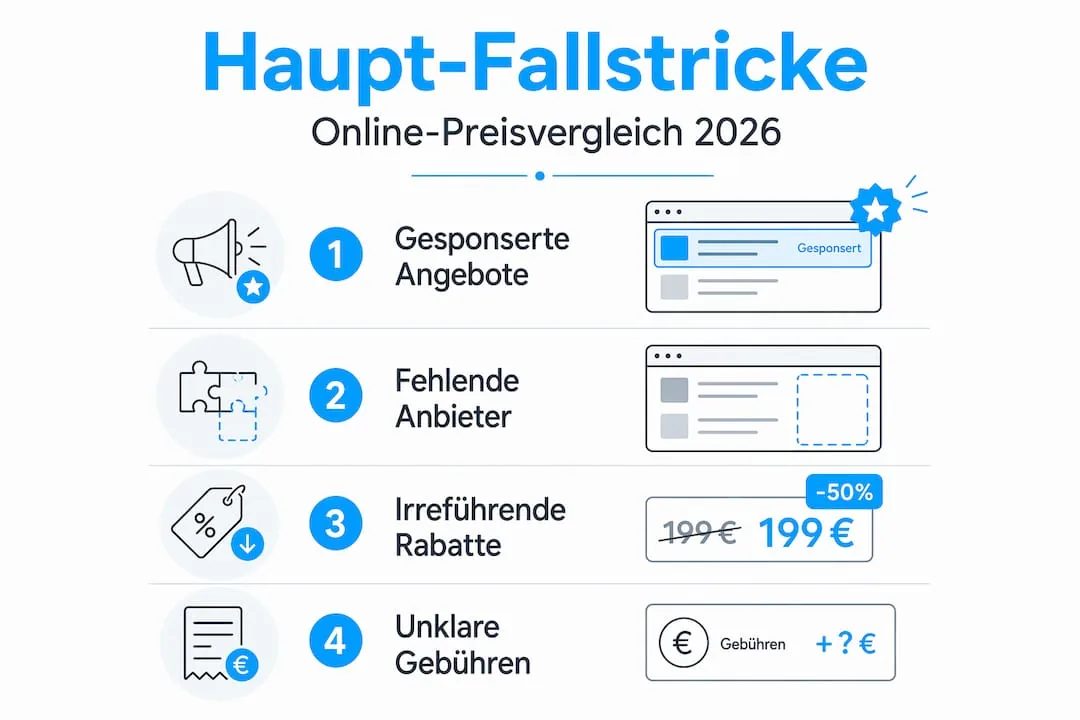
Misleading discounts and manipulated reference prices
A study from April 2026 shows that in 77 % of online discount campaigns the reference (RRP) price is unrealistically high, leading buyers to pay 13 % more on average than they would for the cheapest alternative. That affects not only electronics or fashion but also tariffs and subscriptions advertised with "introductory prices" or "time-limited special conditions". Background reading in our guide Tariff comparison explained.
What is going on behind such practices:
- The regular price is set artificially high so the "reduced" price looks more attractive.
- Shipping fees or service charges only appear at the end of the order process.
- Discounts only apply to certain user groups — for example app users.
"Consumer protection bodies call for more transparency in pricing and an independent online comparison service that lists offers without commercial bias." Read our consumer overview in Compare financial products: save costs.
Market mechanics and ranking influence
Best-price clauses — contracts obliging providers never to be more expensive on a portal than elsewhere — sound consumer-friendly. In reality they restrict competition because providers lose incentive to offer better terms on other channels. The Bundeskartellamt has investigated this practice critically in the energy comparison space.
Other typical problems:
- Sponsored results look optically like organic hits.
- Portals list only providers that pay commission and still suggest completeness.
- User reviews on comparison portals are not always verified independently.
Legal updates 2026 as a protection tool
Since March 2026 § 312i BGB has required online shops and comparison platforms to make input errors recognisable, allow corrections and provide central contract information in time. That measurably improves legal certainty for online purchases. Anyone signing a tariff through a portal now has better options to correct mistakes before signing. Our guide Car insurance 2026: new laws for consumers explains how those legal changes translate into car insurance specifically.
Effective use of comparison tools: step by step
The good news: with a structured approach you can avoid most pitfalls and reliably take better decisions.
Step-by-step tariff choice
- Identify your need: analyse your actual consumption. For electricity: annual kWh from the last bill. For mobile: data volume used in the last three months.
- Pick a comparison portal: use reputable portals with verifiable transparency. Criteria: clearly labelled sponsored content, GDPR-compliant data handling, complete imprint and traceable business model.
- Set filters intentionally: define minimum requirements before sorting results. For mobile: minimum data volume, preferred network, term. For energy: price guarantee, maximum term, bonus exclusion.
- Check the product details: do not just click "sign now". Read the tariff details: base price, working price, notice periods and price-adjustment clauses.
- Take price trajectories into account: for energy it pays to know electricity prices and their development before choosing a tariff. A currently cheap tariff without a price guarantee can become expensive in three months.
- Cross-check with provider: open the provider website in parallel and check whether the same conditions apply there as on the portal.
- Review inputs before signing: thanks to § 312i BGB, portals must allow you to catch errors. Use that option actively before confirming any contract.
How to recognise trustworthy portals
A reputable tariff comparison portal meets these conditions:
- Transparent labelling of paid placements
- GDPR-compliant privacy policy with clear information on data use
- Complete imprint with responsible persons
- Explanation of the ranking criteria
- Customer support reachable across several channels
Pro tip: Briefly call the new provider after the comparison and confirm the conditions on the phone. That gives you extra documentation in case of dispute and clears up misunderstandings immediately.
Background on German electricity comparison portals and how they work helps you pick the right platform for your need.
Editorial take on online comparison tools 2026
by yasin
What I see repeatedly when working with online comparison portals: many users either believe that the cheapest offer is automatically the best, or they trust comparison portals unconditionally as neutral instances. Both attitudes lead to bad decisions.
I have found that consumers who spend a little time understanding how ranking algorithms work consistently make better decisions. Not because they become suspicious, but because they learn to interpret results rather than only consume them. That is a meaningful difference.
What genuinely concerns me: the growing market power of a few large portals creates a dependency that does not serve consumers in the long run. When few platforms dominate access to tariff comparisons, they also decide which providers are visible at all. Calls for more independent comparison services are justified, even if practical execution takes time.
My takeaway: comparison tools are useful if you use them properly. They do not replace your own judgement, but they are an excellent aid once you know which questions to ask. Anyone considering local network quality, comparing total annual cost rather than monthly price and understanding ranking logic can reliably save several hundred euros per year.
— yasin
Compare safely and quickly with meinetarife24
meinetarife24 offers consumers in Germany a clear path to tariffs in energy, insurance and financial products — without hidden costs and with GDPR-compliant data handling. The platform focuses on short input forms and transparent result displays.
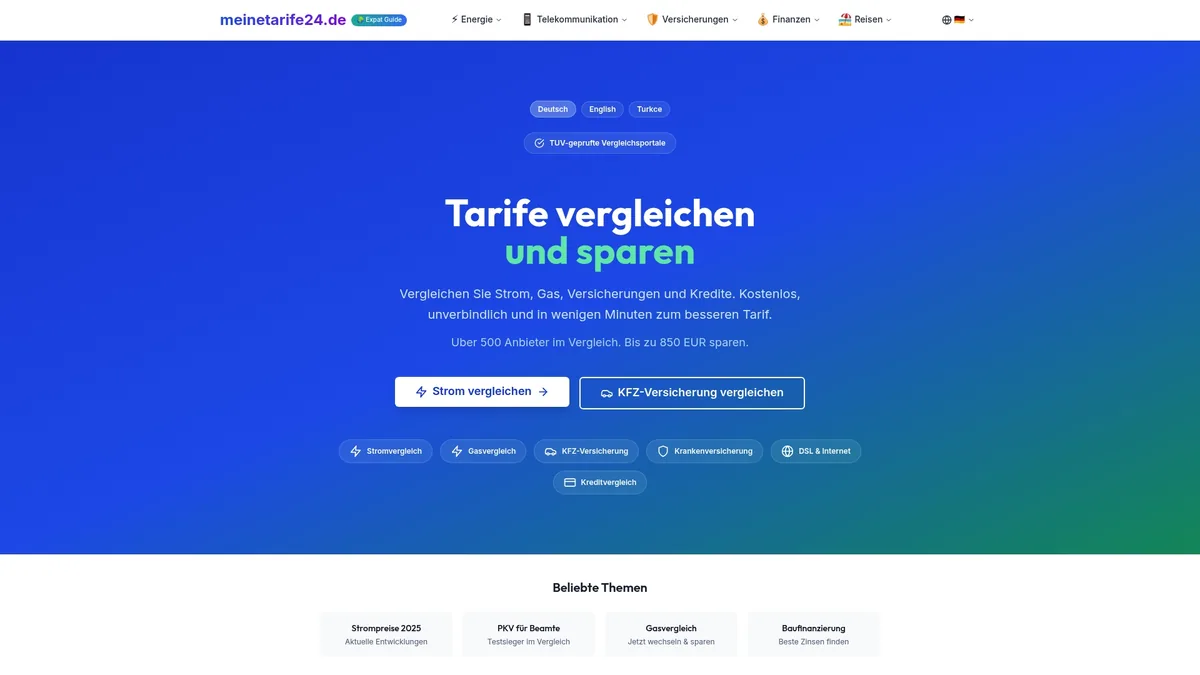
If you want to compare electricity or gas tariffs, the energy guide on meinetarife24 shows current comparison options with savings up to EUR 850 per year. Filters for price guarantee, term and consumption are available for the direct energy provider comparison. Beyond energy, meinetarife24 also covers the insurance comparison, from car to health insurance. The platform is available in German, English and Turkish, making it accessible to expats and international professionals.
Frequently asked questions
What does online comparison mean for consumers in 2026?
Online comparison in 2026 means evaluating tariffs and prices systematically and multi-dimensionally through digital platforms. New rules such as § 312i BGB make the process safer and more transparent than in previous years.
Why is the cheapest tariff not always the best?
The nominal price does not capture quality factors such as network coverage, contract flexibility or hidden fees. The total annual cost — including all components — is the more reliable basis for decisions.
How can I recognise a trustworthy comparison portal in Germany?
Reputable portals clearly label sponsored content, publish a complete imprint (Impressum), explain their ranking criteria and process data in line with GDPR. The absence of disclosure for paid placements is a clear warning sign.
What rights do I have under § 312i BGB when signing a tariff online?
Since March 2026, § 312i BGB obliges providers to make input errors recognisable and correctable, and to disclose key contract information before signing. That gives consumers more control over digital contract conclusions.
How much can I save by switching tariff through an online comparison?
When switching energy tariffs, savings of several hundred euros per year are realistic, depending on annual consumption and the current contract. Platforms such as meinetarife24 estimate savings of up to EUR 850 per year with optimal tariff choice.
Use online comparison the right way
Electricity, mobile or insurance — with the right filters and the protection of § 312i BGB, you can save up to EUR 850 per year.