Benefits of private health insurance in Germany: an expat guide
Updated: 16 July 2026 · meinetarife24 editorial team
The benefits of private health insurance (PKV) in Germany are a coverage package you choose yourself, faster specialist appointments on average, optional extras in hospital and often better dental cover. The drawbacks are premiums that climb with age, a health check when you join, and no free family cover. Whether PKV is worth it for you depends on your job, your income and your family plans. This guide gives you both sides, sourced, from the perspective of an expat, international professional or student navigating the German system for the first time.
Key points at a glance
- · Any qualifying health policy – PKV or GKV – is required proof for your residence permit in Germany.
- · PKV offers individual tariffs, optional extras in hospital and faster specialist appointments on average. Free choice of doctor is not a PKV privilege: you have it in GKV too (§ 76 SGB V).
- · If self-employment is your main occupation, you can choose PKV regardless of income (self-employed artists and publicists are the exception: they are usually compulsorily insured through the Künstlersozialkasse, KSK); employees need a regular annual salary above the JAEG of 77,400 euros in 2026 (6,450 euros per month).
- · Premiums rise with age. On 1 January 2026 they rose for around 60 percent of privately insured people by about 13 percent on average (PKV Association). Stiftung Warentest advises saving several hundred euros a month from the start.
- · Switching back to GKV is heavily restricted from age 55 (§ 6 Abs. 3a SGB V), and leaving Germany usually means giving up the policy – plan ahead if you may not stay.
The most important takeaways
Before we look at the individual benefits, the table below sums up the five points that shape every PKV decision for an international living in Germany.
| Point | Details |
|---|---|
| Individual tariffs | PKV plans can be tailored to your personal needs and health profile. |
| Mind the income threshold | In 2026 employees need a gross annual salary of at least 77,400 euros for PKV access; if self-employment is your main occupation, you are free to choose, unless you are a self-employed artist or publicist insured through the Künstlersozialkasse (KSK). |
| Check the benefits, not the ads | Not every PKV tariff is automatically better than GKV; the contract wording decides. |
| Long-term planning required | Premiums rise with age, so monthly reserves are essential for private patients. |
| Target group matters | Skilled workers, the self-employed and high earners benefit most from PKV. |
Step 1
How to evaluate a PKV plan
Before you can judge the real benefits of PKV, you need to understand which criteria actually matter. The quality of a private health policy does not depend on price alone, but on the combination of several factors – and as a newcomer, a few of them deserve extra attention.
Benefits and deductible: Every PKV tariff defines exactly which treatments are reimbursed and at what level. The deductible – the amount you pay yourself each year before the insurer steps in – directly affects your monthly premium. A higher deductible lowers the premium but increases your financial risk when you do need care. If you rarely fall ill, this often works in your favour.
How premiums develop with age: This is one of the most critical points. PKV premiums rise noticeably with age and Stiftung Warentest recommends putting aside several hundred euros a month early on to cushion these increases. Anyone who underestimates this can come under financial pressure later in life.
Who is allowed to choose PKV: For employees the switch to PKV is only possible if the annual salary exceeds the income threshold (JAEG), which is 77,400 euros in 2026. If self-employment is your main occupation, you are not bound by this limit and can opt for PKV regardless of income. Exception: self-employed artists and publicists are usually compulsorily insured through the Künstlersozialkasse (KSK) and can opt out only in specific cases.
Before signing a contract, check these selection criteria systematically:
- Scope of benefits: Which treatments, dental and hospital services are actually included?
- Premium stability: How has the provider developed its premiums over the past ten years?
- Waiting periods: Do waiting periods apply to certain services such as psychotherapy or dental treatment?
- English-language service: Does the insurer offer English-speaking support and documents you can actually understand?
- Reimbursement principle: PKV reimburses your invoices rather than paying providers directly – so you pay upfront and claim it back.
Expat tip
Ask for the specific contract clauses on psychotherapy, long-term care and outpatient treatment in writing, ideally in English. What looks impressive in marketing can be heavily restricted in the actual policy wording.
Your individual situation also plays a decisive role. People with pre-existing conditions pay higher premiums or face exclusions for certain treatments, while healthy young arrivals benefit from low entry premiums and the build-up of age reserves. For a structured introduction to the basic question, see our guide on how to choose health insurance in 2026.
Step 2
The six most important benefits of PKV
The benefits of private health insurance show up in concrete everyday situations – and several of them matter even more when you are new to the German system. These six points come up again and again.
1. Individual tariff design
PKV plans are not one-size-fits-all packages. You decide which areas of care are covered, how high your deductible is and whether to include extras such as alternative practitioners or international travel cover. Strong tariffs can cover more than the statutory catalogue, for example head-physician treatment or a twin room. It is not automatic, though: Stiftung Warentest examined around 1,245 tariff combinations in 2025 and only 384 met its own minimum criteria. What your plan pays is defined by your contract terms alone.
2. Faster specialist appointments on average
Here is a correction worth making, because most comparison sites get it wrong: free choice of doctor is not a PKV privilege. Under § 76 Abs. 1 SGB V, statutory patients can also choose freely among licensed doctors, and there is no general obligation to get a referral before seeing a specialist. The real difference is the appointment, not the choice. The RWI (Leibniz Institute for Economic Research) measured this in a randomised field experiment calling 991 practices: privately insured callers were offered earlier slots for schedulable appointments. For urgent cases, the Terminservicestellen run by the regional physicians' associations arrange timely appointments for statutory patients too. What genuinely helps you as a newcomer is that free choice makes it easier to pick practices that offer service in English.
3. Optional extras in hospital
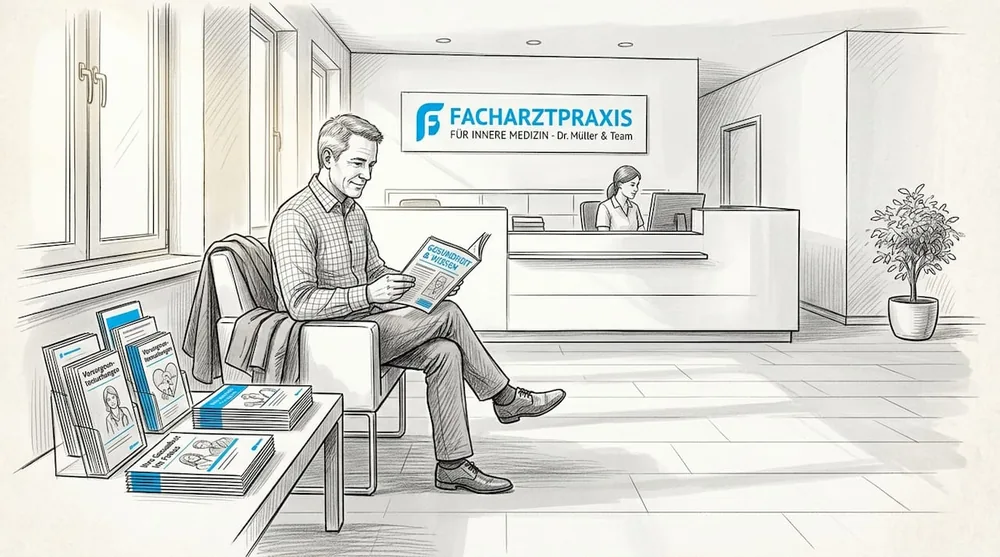
Stiftung Warentest names higher benefits in hospital as one advantage of private cover, for example treatment by the head physician or a single or twin room. These are optional extras (Wahlleistungen): comfort and choice of the treating doctor. The underlying medical care in hospital is the same for statutory patients. And whether your tariff includes these extras at all is written in your contract, not guaranteed by the system.
4. Higher reimbursements for dental work and glasses
Statutory insurance only covers dental prosthetics and glasses to a limited extent. How much your PKV pays at the dentist depends entirely on your tariff terms. As a minimum criterion for a recommendable plan, Stiftung Warentest expects dental treatment covered at 100 percent, and dental prosthetics, inlays and material costs at a minimum of 75 percent. Some tariffs reimburse more, others considerably less. Reading the terms is worth more here than any advertising promise.
Expat tip
Watch the waiting periods. Under § 197 Abs. 1 VVG, the special waiting period for dental treatment, dental prosthetics and orthodontics may not exceed eight months; a general waiting period of up to three months applies to the remaining benefits. Whether your tariff imposes waiting periods at all is set out in its terms.
5. Innovative and complementary treatments
Many PKV tariffs reimburse treatments that are not part of the GKV catalogue. These include alternative-practitioner services, homeopathic treatments, certain preventive check-ups and other complementary methods. Whether you value these services is a personal question – but for many insured people this broader range adds genuine value in everyday life.
6. Premium refunds when you stay claim-free
If you do not claim any benefits during a calendar year, many PKV tariffs refund part of the premiums you have paid. This premium refund can amount to several hundred euros a year. It creates a financial incentive to pay for minor doctor visits yourself and to use your insurance only for treatments that really matter.
There is also a long-term structural benefit: PKV tariffs build age reserves. Part of your premium is set aside to cushion the higher costs of old age. Anyone who joins PKV early benefits from this build-up over decades. To see which tariffs actually include which benefits, start with a comprehensive health insurance comparison.
Step 3
PKV vs. GKV – the real differences
If you are considering private cover, you should compare it soberly with statutory insurance. The table below sets the benefits side by side. For a full decision checklist on the basic question, see our guide on choosing health insurance in 2026.
| Criterion | PKV (private) | GKV (statutory) |
|---|---|---|
| Scope of benefits | Individually selectable, often more extensive | Uniformly defined by law |
| Choice of doctor and specialist access | Free choice of doctor, specialist without referral | Free choice of doctor as well (§ 76 Abs. 1 SGB V); specialists generally accessible without a referral |
| Waiting time for appointments | Shorter on average for schedulable appointments (RWI field experiment) | Longer on average; for urgent cases the Terminservicestellen arrange appointments |
| Hospital comfort | Head physician, single/twin room possible | Standard care in a shared ward |
| Premium calculation | By age, health and tariff | By income (percentage of salary) |
| Family coverage | A separate premium per person | Free co-insurance of family members |
| Switching back | Return to GKV is difficult | More flexible provider changes |
Not all PKV benefits are automatically better than in GKV. Depending on the tariff, psychotherapy and home nursing care can be covered less generously than in the statutory system. And the return from PKV to GKV is barely possible after the age of 55. That is no argument against PKV, but a strong argument for making the decision carefully and backing it with a proper private health insurance comparison.
An honest look
The drawbacks of PKV, explained honestly
A fair guide names the drawbacks of private health insurance, not just the benefits. These are exactly the points that German consumer advice centres (Verbraucherzentrale) and the Federal Health Ministry warn about most often. This is where you find out whether PKV really fits you, especially if you plan to stay in Germany long term.
- Premiums rise with age: This is the biggest drawback. Your income drops in retirement, but the PKV premium stays and keeps climbing. Without your own reserves, that becomes a strain.
- No free family cover: In the statutory system (GKV), children and a spouse or registered civil partner can be insured free of charge, as long as their total income stays below the threshold in § 10 SGB V and they are not mainly self-employed. Unmarried partners do not qualify, even in GKV. In PKV, every family member pays a separate premium.
- The way back is hard: After age 55 a return to GKV is barely possible. That door closes earlier than most people expect.
- You pay upfront: You settle doctors' bills first and claim the money back from your insurer afterwards. That needs disciplined paperwork.
- Health check on entry: If you have pre-existing conditions, you pay risk surcharges or get certain treatments excluded. GKV, by contrast, accepts everyone at the same rate.
None of this rules out PKV. It simply shows that every benefit has a flip side you should plan for from day one. Build reserves early, choose the tariff carefully, and the drawbacks stay small. A level-headed PKV comparison shows which tariffs kept their premiums stable in the past.
Step 4
Who benefits most from PKV
Not everyone benefits equally from PKV. The overview below shows which life situations make the switch particularly worthwhile – with a focus on the groups most relevant to internationals in Germany.
Self-employed and freelancers
Self-employed people and freelancers enjoy full tariff freedom and can adjust both benefits and premiums to their income and health profile. If you are young and healthy, you often pay considerably less in PKV than in GKV. Note, however, that there is no employer contribution, so you carry the full premium yourself – a comparison of comprehensive health insurance helps you find tariffs with stable premium development.
Blue Card holders and skilled workers
Many skilled workers arrive on salaries that already exceed the income threshold, which is what opens the door to PKV for employees. Because private premiums are not tied to income, high earners often pay proportionally less than they would in GKV. At a high annual salary, that difference can quickly add up to several thousand euros a year – just remember to factor in how premiums develop with age.
Well-paid employees
Employees who exceed the JAEG can opt for PKV and still receive an employer contribution. That contribution is capped, which is the part most sites leave out: under § 257 Abs. 2 SGB V your employer pays half of your PKV premium, but no more than the amount it would have to contribute in the statutory system. If your premium is higher, you carry the difference alone. Since PKV premiums are not income-dependent, higher earners still often pay proportionally less than in GKV.
New to Germany: Blue Card holders and international professionals
If you have just moved to Germany, the GKV-versus-PKV question comes up early. Employees can choose PKV as soon as they pass the JAEG. If self-employment is your main occupation, you can choose it regardless of income; self-employed artists and publicists are the exception, because they are usually compulsorily insured through the Künstlersozialkasse (KSK). What often matters most to them is that many PKV tariffs offer fast specialist appointments and English-speaking service. One caveat stays important: a German PKV policy is built around treatment in Germany. If you leave the country, you usually cancel the contract and lose the age-reserves you have paid in.
When GKV is the better choice (especially for mobile internationals)
- · Families with several children and a single main earner
- · People with serious pre-existing conditions that sharply raise PKV premiums
- · Anyone unsure whether they will stay in Germany long term – PKV is built around treatment in Germany, and leaving usually means giving up the policy and its age reserves
- · People with low or strongly fluctuating income
Long-term financial planning is the decisive element here. According to experts, a switch to PKV should not be based on short-term cost savings alone but should always factor in how premiums develop with age. For a deeper expat-focused overview, see our guide on health insurance in Germany for expats in 2026.
Step 5
Practical tips for using your PKV
Deciding on PKV is the first step. The second is using your tariff sensibly over the long term and keeping costs under control – something that takes a little learning when the system is new to you.
Expat tip
From your very first PKV year, set aside a fixed monthly amount as a reserve for rising premiums in old age. Many insured people underestimate how premiums develop with age and come under financial pressure in retirement.
The following measures help you use your PKV well over time:
- Review premiums and benefits regularly: Compare your tariff with current offers every two to three years. Tariff changes within the same company are generally possible under the German Insurance Contract Act (VVG).
- Answer the health questions in full: Incorrect or incomplete details about pre-existing conditions can lead to a claim being refused. Being open protects you in the long run.
- Use the deductible deliberately: A higher deductible lowers your monthly premium. If you rarely see a doctor, you benefit; if you often need care, a lower level is the better choice.
- Submit invoices promptly: PKV works on the reimbursement principle. Submit your invoices quickly and keep an orderly record of all receipts – useful too if you ever need them for tax or visa paperwork.
- Check tariff changes within your PKV: If premiums rise sharply, check whether a cheaper tariff with the same provider offers comparable benefits.
An English-speaking health insurance comparison shows transparently which tariffs currently offer the best value for money and where there is room to optimise – with support you can follow in your own language.
Our editorial take
In public debate, PKV is often either idealised or dismissed outright. Both views lead to poor decisions. For internationals there is an extra layer: if you only look at the low entry premium in your first years in Germany, you can easily lose sight of the long-term picture. PKV is a long-term commitment whose premium development in old age has to be planned for deliberately.
It is also the benefits actually written into the contract – not the marketing – that determine the real advantage. Psychotherapy benefits in particular can be heavily restricted in the fine print, leaving insured people to carry significant costs themselves in an emergency. A close look at the policy terms, ideally in a language you fully understand, is therefore indispensable.
Purely in arithmetic terms, joining PKV early pays off most: a healthy person who joins in their mid-twenties pays lower premiums over decades and builds age reserves for longer than someone who switches at 45. That is not an opinion but the mathematics behind PKV pricing. At the same time, mobile internationals should be especially mindful of the one-way nature of the decision: switching back to GKV is heavily restricted from 55, and leaving Germany usually means giving up the policy. Anyone weighing it up should not be led by short-term cost savings, but should examine the tariff thoroughly, run through retirement scenarios and rely on independent comparisons. PKV can be a very good choice, but only for well-informed people.
Sources & methodology
How we compare, and where the numbers on this page come from
We deliberately do not quote tariff prices for individual insurers on this page. PKV premiums depend on your age, health, profession and plan, so any example figure would mislead you without your personal profile. What we do instead: every legal statement is backed by the statute itself, and every market figure by its primary source. All information is current as of 16 July 2026. Statutory thresholds such as the JAEG change on 1 January, so we review this page annually.
- Free choice of doctor in GKV, specialist without referral: § 76 Abs. 1 SGB V (Gesetze im Internet, Federal Ministry of Justice)
- JAEG 2026 = 77,400 euros (6,450 euros per month): § 2 Sozialversicherungsrechengrößen-Verordnung 2026, in force since 1 January 2026
- Waiting periods (3 and 8 months): § 197 Abs. 1 VVG · Tariff-switching right: § 204 Abs. 1 VVG · Cover only "as agreed": § 192 Abs. 1 VVG
- Employer contribution and its cap: § 257 Abs. 2 SGB V · Family cover: § 10 SGB V · Return to GKV from 55: § 6 Abs. 3a SGB V
- 2026 premium adjustment (around 60 percent of insured, about 13 percent on average) and cost drivers: Association of Private Health Insurers (pkv.de)
- Reserve recommendation, dental minimum criteria, 1,245 tariff combinations tested: Stiftung Warentest (test.de)
- Specialist appointment waiting times: RWI – Leibniz Institute for Economic Research, randomised field experiment across 991 practices
- Age reserves (Alterungsrückstellungen): § 146 Abs. 1 Nr. 2 VAG in conjunction with § 341f HGB
Compare PKV tariffs independently now
Compare PKV tariffs from leading German insurers in just a few minutes – free of charge, transparent and with no hidden costs.
PKV benefits: answers for expats
The five questions internationals ask most often about the benefits of private health insurance.
Häufig gestellte Fragen
Find out whether PKV is right for you
Compare PKV tariffs from leading insurers for free and discover which plan fits your age, profession and health profile.
Go to the free comparisonFree · No obligation · SSL-encrypted
Advertising notice: This page contains affiliate links to our comparison partner Tarifcheck (cpref=197902). If you take out an insurance policy through our comparison, we receive a commission. This involves no additional costs for you, and the results shown are not influenced by it.
meinetarife24.de · Independent tariff comparison · All information without guarantee · Updated: 16 July 2026 · meinetarife24 editorial team