Why Switch Your Energy Provider and Save Money?
Many households in Germany overpay for electricity and gas for years — out of convenience. Switching takes 10 minutes and often saves several hundred euros per year, with no interruption to your supply.
Key takeaways
- Moving from the default Grundversorgung to a competitive tariff saves up to several hundred euros per year.
- A price increase triggers a statutory 14-day special right of termination (Sonderkündigungsrecht).
- Compare on the total annual price — base fee plus per-kWh price minus bonus — not just the bonus headline.
- The supply is guaranteed by German law. There is zero risk of being without electricity during the switch.
The main reasons to switch
If you haven't switched your energy provider in more than a year, you are very likely paying too much. The German energy market is genuinely competitive — but only if you use that competition actively. The whole process takes about 10 minutes.
New-customer bonuses
Many providers offer €50–€200 sign-up bonuses that are deducted directly from your annual bill or paid out as a credit.
Avoid silent price hikes
Most providers raise prices noticeably after 12 months. If you don't switch, you simply absorb the increase. See our guide to price increases.
Sonderkündigungsrecht
If your provider raises prices, you can cancel within 14 days without penalty. Use this right.
Greener tariffs
Switching is also your chance to pick certified Ökostrom (green electricity) — often without paying more.
How German energy tariffs are built
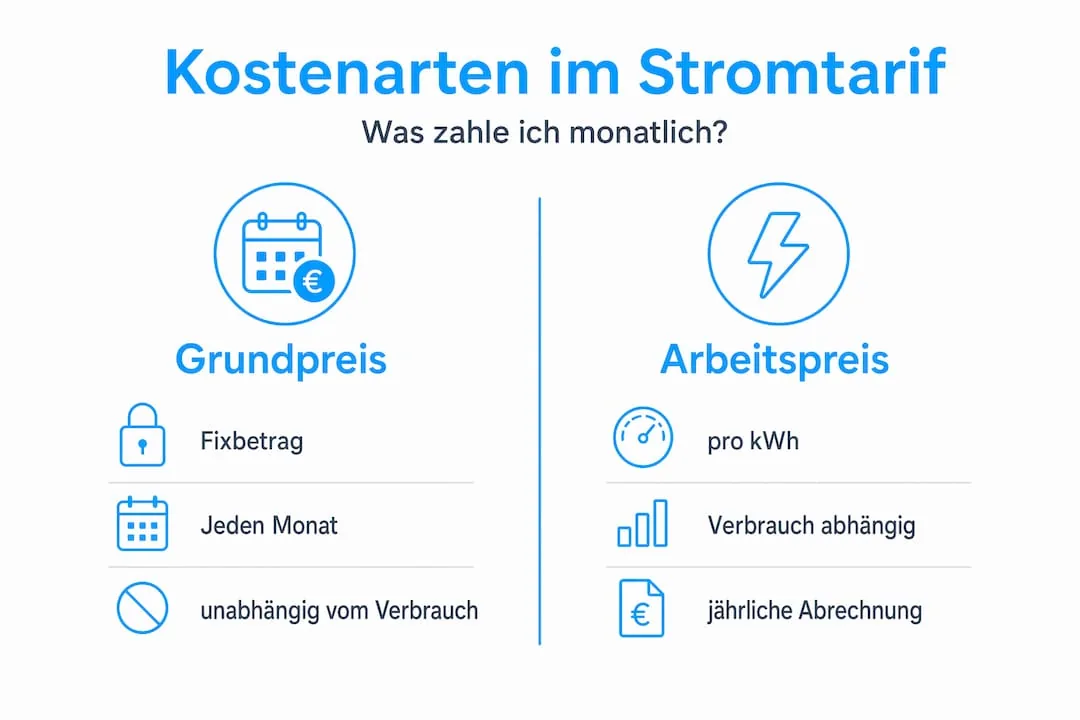
Before picking the right tariff, it helps to understand how prices are composed. Every German electricity and gas tariff has five core parts:
| Component | Description | Typical value (electricity) |
|---|---|---|
| Base fee (Grundpreis) | Fixed monthly amount, independent of consumption | approx. €8–€15 / month |
| Per-kWh price (Arbeitspreis) | Variable price per kilowatt-hour consumed | approx. 28–40 ct / kWh |
| New-customer bonus | One-off discount, usually in the first year | €50–€200 |
| Price guarantee | Period during which the provider cannot raise prices | 12–24 months |
| Contract term | Minimum length before standard cancellation is allowed | 12–24 months |
Pro tip: calculate the real annual cost
base fee × 12 + per-kWh price × annual kWh − bonus. This number is the only honest comparison metric. The Verbraucherzentrale's tariff guide has the same warning about bonus tariffs.
Compare electricity tariffs now
Enter your postcode and annual kWh — see your savings in seconds.
Energy provider comparison
How to switch — step by step
Switching your energy provider is straightforward and never interrupts your supply.
1. Find your usage
Take your annual kWh and meter reading from your last bill
2. Compare tariffs
Use your postcode + annual kWh to find the cheapest offer
3. Switch online
Your new provider cancels the old contract for you
4. Check confirmation
Verify base fee, per-kWh price, contract length and bonus
Use your 14-day special right of termination
When your provider announces a price increase, the Verbraucherzentrale Niedersachsen confirms your right to terminate the contract within 14 days. Plan the switch carefully — see the official energy-advice checklist.
Real savings for German households
Moving from the default Grundversorgung to a competitive tariff makes sense for almost every household:
| Household | Annual usage | Default tariff | New tariff | Savings / year |
|---|---|---|---|---|
| 1 person | 1,500 kWh | €750 | €540 | approx. €210 |
| 2 people | 2,500 kWh | €1,200 | €870 | approx. €330 |
| 4 people | 4,000 kWh | €1,850 | €1,320 | approx. €530 |
Illustrative figures. Actual savings depend on your postcode, usage and tariff.
Why people don't switch — and what to avoid
Fear of losing power
Unfounded — German law guarantees uninterrupted supply during the switch.
Loyalty to your old provider
Loyalty is not rewarded here. The cheapest deals are always for new customers.
Chasing only the bonus
A €200 bonus with a high per-kWh price often costs more than a small bonus with a low per-kWh price.
Trusting one portal only
Comparison portals run on commissions. Cross-check on a second portal or directly on the provider site.
Tip: Compare gas providers separately. The largest savings are often on gas, because annual gas bills are typically higher than electricity bills.
Frequently asked questions
Why should I switch my energy provider in Germany?
Switching usually saves several hundred euros per year, because new-customer tariffs are cheaper than legacy tariffs and the default Grundversorgung. The switch takes 10–15 minutes online and the supply is never interrupted.
How often should I switch electricity provider?
Experts recommend reviewing your tariff at least once a year and switching when a cheaper deal is available, because new-customer bonuses run out after twelve months and prices typically rise afterwards.
What is the special right of termination (Sonderkündigungsrecht)?
When your provider announces a price increase, German law gives you the right to cancel within 14 days without any contract penalty. The provider must announce the change at least four weeks in advance.
Will my electricity be cut off during the switch?
No. The switch happens seamlessly via the existing grid. The wires and the grid operator do not change — only the contract partner for the energy delivery does.
What should I look for in a new energy tariff?
The base fee (Grundpreis), per-kWh price (Arbeitspreis), contract length and price guarantee over the full term matter most. A large new-customer bonus alone is meaningless if the per-kWh price spikes in year two.